Category: Furniture Guides

  • Live Edge Tables: What to Know Before You Buy

    Live Edge Tables: What to Know Before You Buy

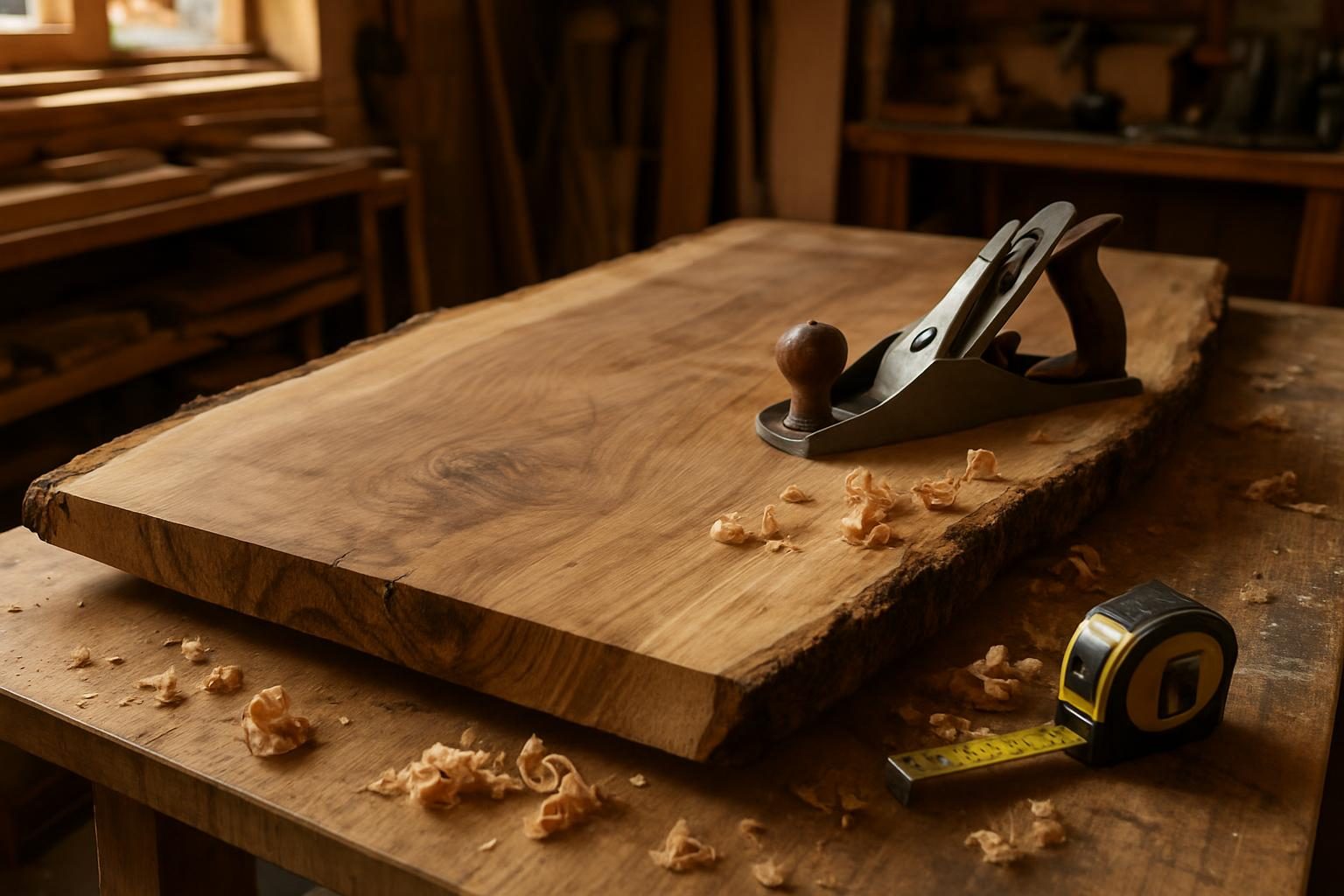
    A live edge table keeps the natural outer edge of the tree along one or both sides, so no two are alike. That is the appeal, and it is also why buying one takes more thought than buying a standard rectangular table. The slab is the whole piece, and its quality decides how the table looks and holds up for the next few decades.

    This guide covers what to look at in a slab, why drying matters so much, which cracks are normal, how to choose a base, and what you should expect to pay.

    The short version

    • A good slab is kiln-dried to roughly 6-8% moisture before it is ever flattened or finished.
    • Small checks and stable, filled cracks are normal. Open cracks that keep moving are not.
    • The base has to let a wide slab move with the seasons, not lock it down.
    • Expect $2,200 and up for a solid live edge dining table, with slab species and size driving the number.
    • Look at the actual slab, or detailed photos of it, before you pay a deposit.

    What a Live Edge Slab Actually Is

    A slab is a single board sawn lengthwise from a log, usually 1.5 to 3 inches thick, with the bark edge left in place or cleaned off. A dining table slab is often 36 to 44 inches wide at its widest point and 84 to 108 inches long. The width changes along the length because trees are not uniform, and that wavy outline is the live edge.

    Most tabletops are made of several narrower boards glued edge to edge. A live edge top is different because one wide piece does the whole job. Wide solid wood moves more across its width than narrow boards do, so everything about drying and base design is built around that fact.

    Drying Is Where Most Problems Start

    Wood that is not dry enough will shrink after you bring it home, and a slab shrinks across its width in a way you can see. Furniture-grade slabs should be dried to about 6-8% moisture content, which matches what the wood settles at inside a heated or air-conditioned house. Air-dried slabs often stall around 12-15%, which is fine for a barn but too wet for a dining room.

    Kiln drying also matters for a practical reason: it kills insects and relieves much of the internal stress in the wood. A thick slab can take months in a kiln, which is part of why good slabs cost what they do. Ask any seller what the moisture reading is and how it was dried. A straight answer is a good sign, and a vague one is not.

    A slab that was not dried properly will finish its drying in your dining room.

    Cracks: Which Ones Are Normal

    Almost every slab has some cracking, because wood dries from the outside in and the ends dry fastest. The question is which cracks are cosmetic and which are structural. Here is a rough way to sort them.

    What you seeUsually meansAction
    Hairline surface checks, especially at the endsNormal drying stressFine as is, or sealed with finish
    A crack running a few inches in from the endEnd checkOften trimmed off or stabilized
    A long crack running most of the lengthInternal stress or poor dryingNeeds inspection before buying
    A crack that has been filled and is stableRepaired flawAcceptable if done cleanly
    A crack that opens and closes with the seasonsNormal movement, or too-wet woodCheck moisture and base design

    Filling a crack with epoxy or butterfly keys (bowtie-shaped inserts) is a legitimate repair, and it can look good. If you want to understand why wood cracks in the first place, why solid wood furniture cracks and how good builders prevent it goes into the mechanics.

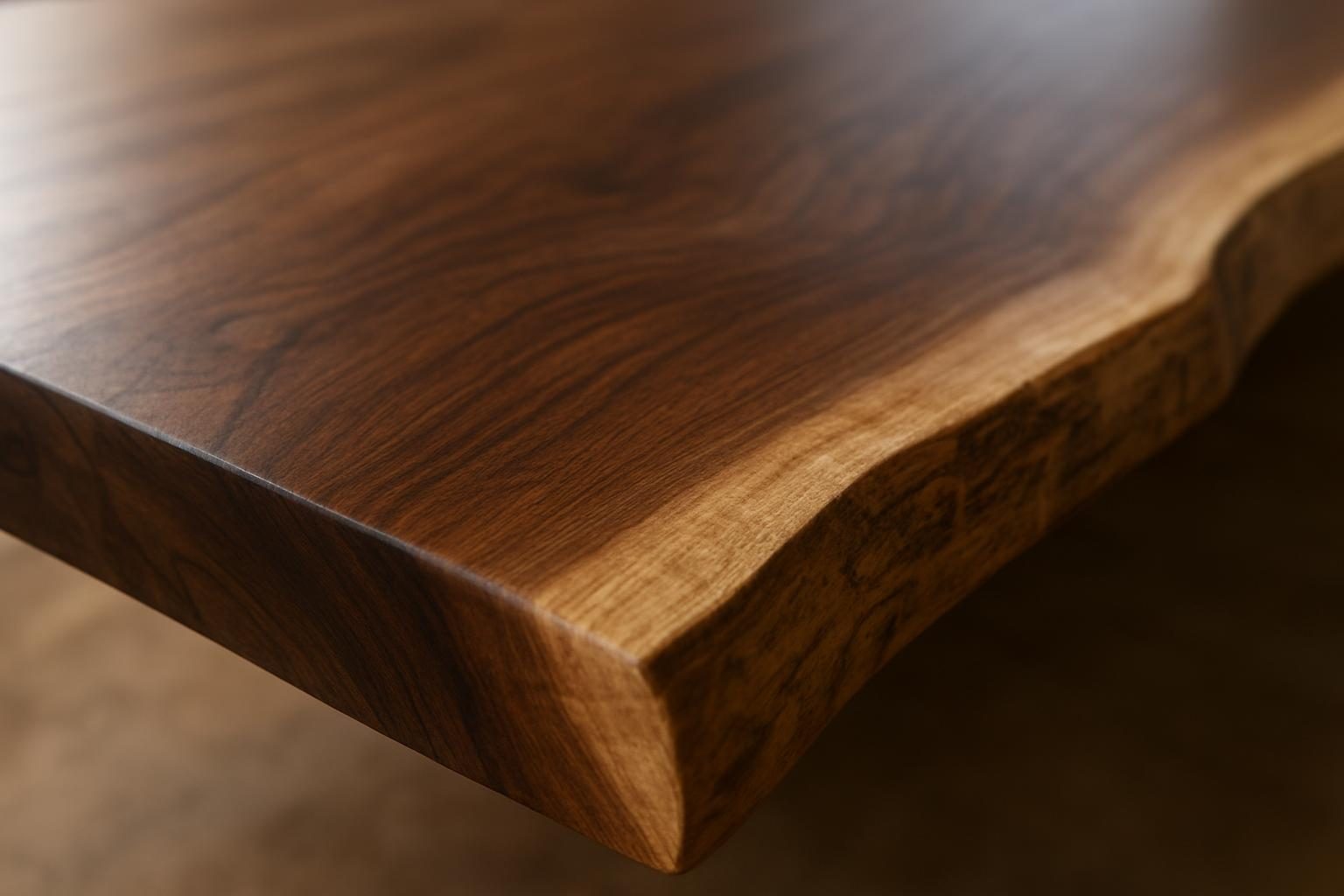
    Close-up of a live edge walnut slab showing grain, a filled crack and a butterfly key

    Species and Slab Selection

    Most live edge dining tables are made from walnut, white oak, maple, cherry or ash. Walnut is the most popular for its dark, even color, and it rates about 1,010 on the Janka hardness scale. White oak is harder at around 1,360 and tends to read lighter and more open in grain. You can compare options in our wood guide, and walnut vs white oak is worth reading if you are torn between those two.

    When you look at a specific slab, check these things:

    • Flatness. A slab that is cupped or twisted has to be milled flat, and that costs thickness.
    • Thickness. Plan on at least 1.75 inches finished for a dining top. Thinner looks light and can flex.
    • Edge quality. Check whether the live edge is sound or if bark and soft wood are flaking away.
    • Knots and voids. Character is fine, but loose knots and hollow pockets need to be stabilized.
    • Grain at the ends. Tight, straight grain behaves better than wild swirling grain over a long span.

    For a deeper walkthrough on one species, see how to choose a black walnut slab.

    Choosing a Base That Lets the Slab Move

    A wide solid slab will expand and contract across its width, in some climates by a quarter inch or more over a year. A base that bolts the slab down rigidly can force the wood to crack as it tries to move. A well-built base fastens in a way that allows for that movement, using slotted holes, elongated cleats or sliding hardware.

    Common base styles for live edge tops are:

    • Trestle: two end supports joined by a stretcher. It shows off the slab and gives good leg room.
    • Four legs with aprons: more traditional, and it adds rigidity, but the apron has to be attached with movement in mind.
    • Steel or hairpin-style bases: a clean modern look, but they must be mounted with slotted connections.

    Trestle bases tend to suit live edge slabs well, and trestle base vs four legs lays out the tradeoffs for your room.

    The best base is the one that holds the slab up without fighting it.

    What a Live Edge Table Costs

    Our solid dining tables start at $2,200, and live edge pieces usually sit above that because the slab itself is expensive. A wide, clean walnut slab can cost far more than the same volume of ordinary lumber, and a rare or unusually figured slab costs more again. Size, species, thickness, base style and finish all change the final number.

    Epoxy river tables are a separate category with a different price and care profile, which epoxy river tables vs solid live edge covers in detail. For a broader look at pricing, how much a custom dining table costs breaks down where the money goes.

    Solid wood trestle base for a live edge table being assembled in a small woodshop

    Finish, Care and Living With One

    A live edge top needs a finish that protects the surface without hiding the grain. Hardwax oil is popular because it looks natural and can be spot-repaired. Polyurethane is tougher against spills but is harder to touch up. You can weigh both in hardwax oil vs polyurethane.

    Day to day, keep the table out of direct sun and away from heating vents, and avoid big swings in humidity where you can. Wipe spills promptly and use trivets for hot dishes. If you are local to Jacksonville, Hubert, Swansboro, Sneads Ferry or the rest of Onslow County, coastal humidity is worth thinking about, because a properly dried slab and a movement-friendly base matter even more in a damp climate.

    Shop tip: Run your hand along the underside of a slab before you buy. A surface that is rough, damp-feeling or has fresh powdery dust can point to poor drying or insect activity, and the underside is where sellers spend the least effort hiding it.

    FAQ

    Are cracks in a live edge table a defect?

    Not always. Small checks and stable, properly filled cracks are normal in air- or kiln-dried slabs. Long cracks that keep opening, or any crack in wood that was not dried to about 6-8%, deserve a closer look before you buy.

    How thick should a live edge dining table top be?

    Aim for at least 1.75 inches finished thickness for a dining table. Thinner tops can look slight and are more likely to flex across a long span.

    Will a live edge table warp?

    Any solid wood top can move with humidity, but a slab that was dried correctly and mounted on a base that allows movement should stay flat and stable. The risk comes from wet wood and rigid fastening.

    If you are ready to talk size, species and base, you can request a quote at /commission/.

  • Rounded Edge Coffee Tables: Edge Profiles and Family-Friendly Design

    Rounded Edge Coffee Tables: Edge Profiles and Family-Friendly Design

    A coffee table sits at exactly the height of a toddler’s forehead and an adult’s shin. That’s why the edge matters more here than on almost any other piece of furniture. A square, sharp-cornered edge is fine until the first stumble; a well-rounded one is something you stop thinking about.

    The short version

    • Rounding an edge is about two things: what happens when someone bumps it, and how well the finish survives daily wear.
    • A 1/4 inch roundover is the minimum for comfort; 1/2 inch or more is a better fit for a home with small children.
    • Rounded corners (a radius in the tabletop’s plan view) matter as much as rounded edges.
    • Harder woods like white oak and maple hold a soft edge longer than softer ones like pine or cherry.
    • Our coffee tables start at $850, and edge profile is something you choose when you commission.

    Edge vs. Corner: Two Different Kinds of Rounding

    People say “rounded edge” and mean two things. The edge is the long arris running along the top and bottom of the tabletop, which you can round with a router bit or hand plane. The corner is the shape of the tabletop itself when viewed from above, where a 90-degree point can be left sharp or cut to a curve.

    For a family room you usually want both. A table with a generous roundover but square corners still has four points sticking out at knee and head height. A table with rounded corners but a razor-crisp edge still feels sharp under a forearm or a hip.

    If you’re choosing between them, put the budget into the corners first. A corner radius of 2 to 4 inches takes the point out of the table entirely, and it costs only a little more labor than a square corner.

    The Common Edge Profiles, Compared

    Not every soft edge is the same shape, and each one changes how the table looks and feels. Here are the profiles we get asked about most, and what they’re good for.

    ProfileWhat it looks likeBest for
    Small roundover (1/8 to 1/4 in)Crisp, modern, barely softenedAdult households, clean contemporary lines
    Medium roundover (3/8 to 1/2 in)Clearly soft, still definedMost family rooms; good all-around choice
    Full bullnose (about 3/4 in, half the thickness)Fully rounded, almost pillowyToddlers, rental-friendly feel, farmhouse styles
    Eased edge (just broken, about 1/16 in)Looks square, feels safe to touchMinimalist tables where you don’t want a visible profile
    Chamfer (angled cut)Flat bevel, angularMid-century and Shaker-leaning styles

    The eased edge deserves a mention because it’s often overlooked. It reads as a square-edged table in a photo but won’t chip or catch a fingernail, which makes it a good middle path if you like the crisp look.

    Router with a roundover bit shaping the edge of a hardwood tabletop in a small woodshop

    A soft edge is a kindness you only notice when you bump it.

    Which Radius Should You Pick?

    For the tabletop edge, think in terms of the thickness of the top. Most solid coffee tables run 1-1/2 to 2 inches thick. A roundover of 1/2 inch on a 1-1/2 inch top looks balanced; push it to a full 3/4 inch bullnose and the whole top reads as rounded.

    For corners, the radius is measured as if you were drawing a circle at the corner. A 1 inch radius still feels pointy to a child; 3 inches is where the corner stops reading as a corner. On a standard 48 by 24 inch rectangular top, a 3 inch radius is a gentle softening, and 6 inches starts to look like a rounded rectangle.

    If your sofa sits close and the table lives in a tight walkway, go bigger on both. The sizing guide in Coffee Table Size Guide: Length, Height and Distance from the Sofa covers how far the table should sit from the seating, which affects how often you’ll catch an edge.

    Wood Choice and How Long the Edge Lasts

    A rounded edge only stays rounded if the wood underneath can take a knock. Softer woods dent and compress at the very edge, and that’s where kids drag toys and adults set down mugs. Hardness is measured by Janka rating, and the spread across common furniture woods is wide.

    • Hard maple: about 1,450 lbf. Very dense, takes a smooth, tight edge, and resists denting well.
    • White oak: about 1,360 lbf. Hard and open-grained, a strong all-rounder for family tables.
    • Black walnut: about 1,010 lbf. A good balance of workability and durability; dents a little more than oak but hides it well in the grain.
    • Cherry: about 950 lbf. Softer, and it will pick up small dings over the years, though many people like that worn look.

    For a table that will see real use, we lean toward white oak or maple. If you want to see the species side by side, the wood guide lays them out, and Walnut vs White Oak: Which Is Better for a Dining Table? explains the trade-offs that carry over to a coffee table.

    Solid hardwood coffee table with rounded corners in a living room beside a sofa

    Finish Matters at the Edge Too

    Edges are where a finish wears through first, because they take the most contact and the thinnest coat. A hard film finish like polyurethane stays smooth but can chip along a sharp edge; a rounded edge holds the film better because there’s no thin ridge for it to break off.

    A hardwax oil is easier to touch up and feels more natural under the hand, which suits a rounded edge that gets handled constantly. We compare the two in Hardwax Oil vs Polyurethane: Choosing a Table Finish, and the right pick depends on how much maintenance you’re willing to do.

    Shop tip: Run your fingertip along the underside edge of any table you’re considering, not just the top. Makers often round the top beautifully and leave the bottom arris sharp, and that’s the edge little hands grab when they pull themselves up.

    Shape, Size and Where the Table Goes

    Edge profile and overall shape work together. A round or oval top has no corners at all, which is the safest option for a room with crawling or newly walking children. A rectangle with generously rounded corners gives you more surface area while still softening the hit zones.

    Standard coffee table heights run 16 to 18 inches, ideally a little below the seat height of your sofa. Length is usually about two-thirds the length of the sofa, so a 84 inch sofa pairs well with a table around 48 to 56 inches. Leave 14 to 18 inches between the table and the sofa so people can pass and get in and out of the seat.

    If you’re in Jacksonville or elsewhere in Onslow County, we can deliver or you can pick up locally, which makes it easy to see the edge in person before it goes into your room. You can browse the options on our coffee tables page and see how a commission moves from sketch to finished piece on the process page.

    Good design for a family room starts with where the corners land.

    What to Ask When You Commission

    When you’re specifying a table, be concrete about the edge. “Rounded” is not enough information, and different makers will interpret it differently. Give a number and a shape so the quote matches what you’re picturing.

    • Tabletop edge profile and radius (for example, 1/2 inch roundover top and bottom).
    • Plan-view corner radius (for example, 3 inch corners).
    • Whether the leg and apron edges are eased or rounded too.
    • Species and finish, since both affect how the edge wears.

    We quote a fixed price after we’ve agreed on these details, with a 50% deposit to start the build. Our coffee tables begin at $850, and the edge work is part of the design conversation rather than a surprise add-on.

    FAQ

    What is the safest edge for a coffee table with toddlers?

    A full bullnose or a roundover of 1/2 inch or more, combined with plan-view corners rounded to a 3 inch radius or larger. A round or oval top removes corners entirely and is the safest shape.

    Do rounded edges cost more?

    Slightly, because they take more shaping and sanding time than a plain square edge. The difference is small compared with the overall cost of a solid wood table, and it’s worth it for a table that sits at head height for small children.

    Can I round the edges of my existing coffee table?

    Often yes, if the top is solid wood and thick enough, using a router with a roundover bit followed by sanding and refinishing the edge. Veneered tops are risky because you can cut through the thin face layer, which is covered in Solid Wood vs Veneer Furniture: What You’re Really Paying For.

    If you’d like a coffee table with the edge profile and corner radius worked out for your room, you can request a quote at /commission/.

  • Mid-Century Modern Coffee Tables in Solid Wood

    Mid-Century Modern Coffee Tables in Solid Wood

    The short version

    • The look comes from low, light proportions: roughly 15 to 17 inches tall, with legs that taper and splay slightly.
    • Walnut is the classic choice, but white oak, cherry and maple all work if you match the finish to the room.
    • Legs should taper on the inside faces, from about 1-3/4 inches at the top to 3/4 inch at the floor.
    • A solid wood version starts around $850 and rises with size, species and joinery.

    Mid-century modern furniture looks easy to copy, and that’s the trap. The shapes are so clean that any mistake in proportion shows immediately. A leg that’s a quarter inch too thick or a top that’s two inches too deep can turn an elegant piece into a clunky one.

    This guide covers what actually defines the style in a coffee table, which woods suit it, and the dimensions we use when we build one. If you want to look at what we make before reading on, our coffee tables page shows the range.

    What Defines a Mid-Century Modern Coffee Table

    The style grew out of the 1940s through the 1960s, when designers wanted furniture that was honest about its materials and light on its feet. In a coffee table, that comes down to a handful of traits. You can check any table against them.

    • Low and horizontal. Most sit 15 to 17 inches tall, lower than a typical contemporary table.
    • Tapered legs. The legs get thinner toward the floor, often angled outward a few degrees.
    • Visible wood grain. Walnut, teak and oak were standard, usually with a clear oil or light finish.
    • Clean edges. Square or softly eased edges, rather than heavy profiles or applied trim.
    • Space under the top. Thin aprons or none at all, so you can see through the table.

    Notice what’s missing: ornament. The design is the proportion, the wood and the joinery. That’s why a mid-century modern coffee table in solid wood feels different from a veneered copy, since the grain and edges carry the whole look.

    When a design has no decoration, every dimension has to be right.

    Tapered Legs: Where the Style Lives

    If you only get one thing right, make it the legs. A tapered leg lightens the whole table, because your eye reads the thin foot and assumes the piece is delicate. A straight leg of the same thickness reads as heavy.

    A good starting point is a leg about 1-3/4 inches square at the top, tapering to roughly 3/4 inch at the floor. We usually taper the two inside faces and leave the outside faces straight, which keeps the leg flush with the edge of the top and gives a clean line from above. Tapering all four faces is a valid choice too, though it changes the feel to something a little more delicate.

    Splay is the second decision. A slight outward angle, around 5 to 8 degrees, gives the table that planted, confident stance. Splayed legs are harder to build, because the joints to the apron or top are cut at compound angles. That extra work is a real part of the price, and it’s also what separates a well-made table from a flat-pack one.

    Close-up of a tapered walnut coffee table leg joined to the underside of the top

    Why Walnut Fits the Style

    American black walnut is the wood most people picture. It has a Janka hardness of about 1,010 lbf, which is firm enough for daily use and soft enough to work cleanly into fine tapers. Its color runs from chocolate brown to purple-gray, and a clear oil finish deepens it without hiding the grain.

    Walnut isn’t the only good option, though. White oak (around 1,360 Janka) gives a lighter, calmer look and pairs well with the Scandinavian side of the style. Cherry (about 950) starts pale and darkens, which we cover in why cherry wood darkens. Hard maple (about 1,450) is the lightest and hardest of the group.

    SpeciesJanka (lbf)LookBest for
    Black walnut~1,010Deep brown, warmThe classic mid-century look
    White oak~1,360Light tan, subtle grainLighter, Scandinavian-leaning rooms
    Cherry~950Reddish, darkens over timeWarm rooms that welcome patina
    Hard maple~1,450Pale, uniformBright, minimal spaces

    For a deeper species comparison, see our wood guide. If you’re choosing between the two most popular options, the post on walnut vs white oak applies to coffee tables as well, since the wood behaves the same way at any size.

    Pick the wood for the room it will sit in, not just the style it comes from.

    Proportions: The Numbers We Work From

    Here’s where the style becomes practical. These are typical dimensions for a rectangular mid-century modern coffee table, and they’re a starting point rather than a rule. The right size depends on your sofa and your floor space, which our coffee table size guide walks through in detail.

    • Length: 44 to 54 inches, about two-thirds the length of the sofa.
    • Width: 22 to 28 inches. Narrower than a modern chunky table, which keeps it light.
    • Height: 15 to 17 inches, ideally within an inch of the sofa seat height.
    • Top thickness: 3/4 to 1-1/4 inches. A thin top with eased edges looks refined, while a thick slab looks rustic.
    • Distance to sofa: 14 to 18 inches, so you can reach your drink and still walk past.

    Top thickness is the dimension people overlook. Mid-century tables usually have slim tops, sometimes with a slight bevel on the underside so the edge looks thinner than it is. A 1-1/2 inch slab on tapered legs fights the style, because the heavy top visually overwhelms the delicate legs.

    Walnut boards and hand tools on a workbench in a small woodshop

    Solid Wood vs Veneer for This Style

    Plenty of mid-century modern coffee tables, including many vintage originals, use veneer over a core. There’s nothing wrong with good veneer work, but the clean, edge-forward design shows its weakness more than most. Visible edges are where veneer tables give themselves away.

    A solid top can be sanded and refinished for decades, so a ring or scratch isn’t permanent. We break down the tradeoffs honestly in solid wood vs veneer furniture. For a table that will sit in a living room for twenty years, solid is usually the better value even at a higher starting price.

    Shop tip: Check the top from a seated position before you commit to a height. If the table sits much above the sofa seat, it will feel like a barrier. Right around the seat height, it feels like part of the room.

    Finish and Care

    A mid-century look usually calls for a finish that stays close to the wood. Hardwax oil gives a soft, natural sheen and is easy to spot-repair, while polyurethane gives a harder surface film that resists spills. We compare them in hardwax oil vs polyurethane.

    For a coffee table that gets coasters, remotes and the occasional mug, either works if you keep up with it. Wipe spills promptly, use coasters for hot cups, and re-oil an oiled surface once or twice a year. The care routine is the same one we outline for tables of any size.

    What a Solid Wood Version Costs

    Our coffee tables start at $850, and a mid-century style piece in walnut typically lands above that starting point. Price moves with length, species, how much splay and taper the legs have, and any extras like a lower shelf or a drawer. Walnut costs more than oak or maple per board foot, so species is often the biggest single factor.

    Every commission gets a fixed quote and a 50% deposit, so there are no surprises as the build goes on. If you’re curious how the steps run from first message to finished piece, how a commission works lays it out. We build for homes across Jacksonville, NC and Onslow County, including Hubert, Swansboro, Sneads Ferry and Richlands, with local pickup or delivery.

    FAQ

    How tall should a mid-century modern coffee table be?

    Most fall between 15 and 17 inches. The best rule is to match your sofa seat height within about an inch, so the table feels level with where you sit.

    Is walnut the only wood for a mid-century look?

    No. Walnut is the classic choice, but white oak, cherry and hard maple all suit the style. The shape, tapered legs and slim top matter more than the species.

    Why are tapered legs more expensive to build?

    Each leg needs extra machining to cut the taper cleanly, and splayed legs add compound-angle joinery. That’s more setup and more careful fitting than a straight square leg, which is why well-made versions cost more than flat-pack ones.

    If you’d like a mid-century modern coffee table built to your room’s dimensions, you can request a quote at /commission/.

  • French Country Dining Tables: Style Details, Woods and Sizes

    French Country Dining Tables: Style Details, Woods and Sizes

    The short version

    • French country tables are defined by shaped legs (turned, cabriole or tapered), a rounded or beveled edge and a soft, lived-in finish, not by a single fixed design.
    • Oak, cherry and walnut all suit the style; oak is the most traditional, cherry is the warmest, and walnut reads darker and more formal.
    • Plan on 36 to 42 inches wide and 72 to 96 inches long for most rooms. An oval or a table with a drop leaf softens tight spaces.
    • Custom dining tables in our shop start at $2,200. Heavier carved or turned work sits toward the upper end of the range.

    What actually makes a table French country

    French country is a style, not a blueprint. Think of the tables you would find in a farmhouse in Provence or Normandy: sturdy, a little worn, built to be used every day, but with more curve and grace than a plain American farmhouse table. The look comes from a handful of details working together.

    If you are weighing it against a plainer look, our post on farmhouse dining tables covers the squarer, more utilitarian cousin. French country borrows the same honest construction but adds shape.

    • Legs with some character: turned (lathe-shaped) legs, gently curved cabriole legs, or a tapered square leg with a fluted or reeded face.
    • A softened edge: a rounded-over or beveled top edge rather than a sharp 90-degree corner.
    • An apron with detail: the rail under the top is often shaped, scalloped or has a simple molding.
    • A warm, matte finish: satin or low sheen that lets the grain show, sometimes lightly distressed or limewashed.
    • Generous proportions: a table that feels solid and a bit stately without being fussy.

    Leg and base styles that fit the look

    The base does most of the style work. A plain post leg reads modern; the same table on turned or curved legs reads French country at once. Pick the base first, because it drives the cost and the seating plan.

    Turned legs are made on a lathe and run from simple tapered forms to bold bulbs and rings. They are the most traditional choice and they hold up well because the grain runs straight down the length of the leg. A cabriole leg curves out at the knee and back in at the foot; it is more elegant, but the curve means more waste and more shaping time, so expect it to cost more.

    A trestle base is another good fit if you want something sturdy and open. It also leaves more room at the ends for chairs. We compare the two layouts in trestle base vs four legs, which is worth reading before you commit to one.

    The base sets the style; the top just has to be flat, thick and honest.

    Close-up of a turned hardwood table leg and shaped apron on a dining table

    Woods that suit French country

    You have three realistic choices, and each gives a different feel. None is wrong; it depends on how formal you want the room to read and how much color change you can live with. Our wood guide lays the species side by side.

    SpeciesJanka hardnessLook in this styleNotes
    White oak1,360 lbfLight to mid-brown, visible grainThe most traditional pick; very durable and takes a limewash or soft stain well.
    Cherry950 lbfWarm reddish-brown, darkens with ageFine, even grain suits curved work; see why cherry darkens.
    Walnut1,010 lbfDeep chocolate brown, more formalReads richer and darker; pairs well with pale linen and stone.

    If you cannot decide between the two most popular, walnut vs white oak walks through the trade-offs. As a rule of thumb, oak leans country, walnut leans formal, and cherry sits in between and ages beautifully.

    Sizes: how big should the table be

    Start with how many people you seat on a normal night, then add for holidays. A comfortable place setting takes about 24 inches of table edge per person. A table 36 to 42 inches wide gives you room for plates and a few serving dishes without anyone reaching across a canyon.

    • Seats 4 to 6: about 60 to 72 inches long.
    • Seats 6 to 8: about 72 to 96 inches long.
    • Seats 8 to 10: about 96 to 108 inches long, which needs a room at least 14 feet in the long direction.

    Leave 36 inches of clearance between the table edge and the wall so chairs can pull out, and closer to 42 to 48 inches if people walk behind them. Our guides on what size table seats 8 and measuring your dining room go through the numbers with a tape measure in hand.

    Wood samples of white oak, cherry and walnut laid side by side on a workbench

    Shape: rectangle, oval or round

    French country leans toward softer shapes. An oval top removes the sharp corners that catch hips and knees, and it makes a room feel less boxed in. A round table works well for smaller rooms and conversation-heavy households, though it tops out around 60 inches before reaching across gets awkward.

    A rectangular table is still the practical choice for most long, narrow dining rooms and it seats the most people per square foot. We cover the pros and cons in round vs rectangular dining tables. If you want the French feel on a rectangle, a generous rounded-over edge and shaped legs get you most of the way there.

    Soft corners and a thick edge do more for the style than any amount of carving.

    Finish and the lived-in look

    The finish should look like it has been used and loved, not like a showroom floor. A hardwax oil gives a low-sheen, natural look that is easy to touch up, while a catalyzed or polyurethane finish is harder wearing for a busy family table. We break down that choice in hardwax oil vs polyurethane.

    Limewash, a light wire-brushing or a soft distress can add the aged look, but they are decisions to make before the build, not after. Heavy distressing on a new top is something to approach carefully: a few honest nicks look right, while a top beaten to look 200 years old can look forced.

    Shop tip: Ask for a finish sample on the exact species you are choosing. Cherry and oak take the same stain very differently, and a swatch on the real board saves you from a color surprise.

    What it costs and how it gets built

    Custom dining tables from our shop start at $2,200, with the final number set by size, species, base and how much shaping is involved. A plain oak top on straight tapered legs sits near the low end, while a large cherry or walnut table with turned or cabriole legs and a shaped apron climbs from there. How much a custom dining table costs breaks the factors down in detail.

    We work from a fixed quote and a 50% deposit, and you can read the full sequence on how a commission works. We build a few pieces a month, so there is a lead time, and local pickup or delivery is available around Jacksonville, Hubert, Swansboro, Sneads Ferry, Richlands and the Camp Lejeune area.

    FAQ

    Is French country the same as farmhouse?

    No. Farmhouse tends toward straight lines, thick square legs and a plain, utilitarian look. French country adds curves, shaped legs and a more refined edge, though both favor honest solid wood and a worn, comfortable finish.

    What is the best wood for a French country dining table?

    White oak is the most traditional and the most durable, cherry gives a warm tone that deepens with age, and walnut gives a darker, more formal look. All three are hardwoods that hold up to daily meals.

    How wide should a French country dining table be?

    Most are 36 to 42 inches wide, which fits plates and serving dishes comfortably. Go wider than 42 inches only if you have the room and do not mind reaching across for the salt.

    If you have a room and a look in mind, request a quote at /commission/ and we will talk through species, base and size.

  • Mid-Century Modern End Tables in Solid Wood: Sizes and Styles

    Mid-Century Modern End Tables in Solid Wood: Sizes and Styles

    The short version

    • Set the table height within 2 inches of your sofa arm, usually 22 to 26 inches.
    • Most mid-century end tables run 16 to 24 inches wide or in diameter, and 18 to 24 inches deep.
    • Tapered, splayed legs and clean edges define the style; thin tops and slim legs only hold up in solid hardwood with real joinery.
    • Walnut is the classic choice, white oak and cherry are strong alternatives, and a hardwax oil finish keeps the look right.
    • Expect a custom solid wood end table to start in the low hundreds and climb with size, drawers and species.

    What makes an end table mid-century modern

    The style comes from roughly the 1940s through the 1960s, when designers wanted furniture that was simple, light on its feet and honest about how it was made. On an end table, that shows up as a few repeatable traits: tapered legs, often angled outward; a top with slightly eased or beveled edges; and almost no ornament. The wood grain is the decoration.

    Because the pieces are small and open, there is nowhere to hide weak construction. A thin top on skinny legs looks elegant when it is built right and wobbly when it is not. That is why the style suits solid hardwood so well, and why solid wood versus veneer is worth understanding before you buy.

    Standard sizes for mid-century end tables

    End tables are small, so a couple of inches changes how the piece looks next to a sofa or bed. The ranges below cover most rooms.

    StyleTypical top sizeTypical heightBest for
    Square or rectangular, 16 to 20 in wide16 to 20 in x 18 to 22 in22 to 25 inTight spots, apartment sofas
    Rectangular with drawer18 to 24 in x 20 to 24 in22 to 26 inLiving rooms that need storage
    Round18 to 24 in diameter22 to 26 inTraffic paths, softer lines
    Nightstand-height16 to 22 in x 16 to 20 in24 to 28 inBeds with higher mattresses

    For the living room, the usual rule is to match the table height to the sofa arm, or land within about 2 inches below it. A table taller than the arm tends to feel like a wall; a much lower one makes you reach down for your coffee. If you are pairing it with a coffee table, the coffee table size guide covers how the two heights and distances work together.

    Legs, tops and the details that sell the look

    Leg shape does most of the work. Here are the common options and how they read in a room:

    • Tapered straight legs: 1.5 inches square at the top narrowing to about 3/4 inch at the floor. The safest, most versatile choice.
    • Splayed (angled) legs: set out 5 to 10 degrees, which gives the classic dowel-leg look and a more stable footprint.
    • Hairpin or metal legs: a different feel, lighter and more industrial. Solid wood legs are warmer and last longer under a heavy lamp.
    • Tripod base: three legs, usually under a round top. Stable on uneven floors because three points always touch.

    On the top, look for a thickness of 3/4 to 1 inch with a soft chamfer or roundover underneath so it looks thin without being fragile. A single drawer, flush or with a small recessed pull, adds storage without breaking the clean lines. Skip heavy trim, and the table keeps its shape.

    Close-up of a tapered walnut end table leg joined to the apron with a mortise and tenon joint

    On a small table, the proportions are the whole design.

    Choosing the wood: walnut, white oak or cherry

    Walnut is the species most people picture. It runs about 1,010 on the Janka hardness scale, machines cleanly, and has a deep brown tone that suits the era. White oak is harder at around 1,360, with a lighter, more neutral color and a straight grain that looks good with tapered legs. Cherry sits near 950 and starts lighter before it deepens over time, which is worth knowing; why cherry wood darkens explains what to expect.

    None of these is a wrong answer, so pick by the room and the look you want. Our wood guide compares the species side by side, and the walnut versus white oak comparison applies just as well at end-table scale. On a table this small, you can also be choosier about the boards, since there is only one top to match.

    Joinery that keeps small tables from wobbling

    A table with four slim legs has less margin for error than a heavy one. The legs should join to the aprons with mortise-and-tenon joints, not screws or dowels alone, because those joints resist the racking force every time someone leans on the top. Glue and a snug fit do the rest.

    The top needs room to move with the seasons. A solid wood top will expand and shrink across the grain by a fraction of an inch through the year, so it should attach with figure-8 fasteners or slotted screw holes rather than being glued down tight. Gluing a top rigidly is a common reason furniture splits, covered in why solid wood furniture cracks. At this size the movement is small, but the principle is the same.

    Shop tip: Before you order, cut a piece of cardboard to the top size and set it next to your sofa or bed. Check that it clears walkways, lamps and the arm height, and that you can still reach it from a seated position.
    Three small end tables in walnut, white oak and cherry showing different wood tones and grain

    A good end table disappears into the room until you reach for it.

    Finishes and everyday wear

    An end table takes more abuse than people expect: sweating glasses, phones, lamp bases, the odd mug of coffee. For the matte, natural look that suits this style, a hardwax oil works well and can be spot-repaired if a ring or scratch shows up. A film finish like polyurethane gives more resistance to standing water but looks more plastic and is harder to repair locally. The trade-offs are laid out in hardwax oil versus polyurethane.

    Coasters are the cheapest insurance you can buy. If a white mark does appear, removing water rings is usually a quick fix on an oiled surface, and basic care for a solid wood table keeps the finish looking right for years.

    What a custom end table costs

    Our pricing starts at $850 for coffee tables and $550 for benches, and end tables are smaller pieces, so they usually come in below those starting points. The price moves with species, size, whether there is a drawer, and how much shaping the legs need. A simple tapered-leg table in walnut costs less than a round-top tripod with a drawer in figured wood, simply because of the hours involved.

    Every quote is fixed with a 50% deposit, so you know the number before work begins, and how a commission works walks through the steps. If you are in Jacksonville, Hubert, Swansboro, Sneads Ferry or anywhere else in Onslow County, pickup is straightforward, and delivery is available for furniture.

    Two end tables are often cheaper per piece than one-offs because the setup, milling and finishing are shared. If you want a matching set with a coffee table, our coffee tables page shows what we build.

    FAQ

    What height should a mid-century end table be?

    Most land between 22 and 26 inches, and the best match is within about 2 inches of your sofa arm. For beside a bed, measure from the top of the mattress, since nightstand height usually runs a bit taller at 24 to 28 inches.

    Is solid wood or veneer better for a mid-century end table?

    Solid wood holds up better at this scale because the thin tops and slim legs take real stress and can be sanded and refinished later. Veneer can look fine initially but chips at edges and is hard to repair. The full comparison is in solid wood vs veneer furniture.

    Which wood is most authentic for mid-century modern?

    Walnut is the species most associated with the style, with teak and oak also common in original pieces. Today walnut, white oak and cherry are the practical solid hardwood choices, and any of them suits the clean lines.

    If you have a corner or a sofa in mind, request a quote at /commission/ and we will price the size and wood you want.

  • Reclaimed Wood Dining Tables: Pros, Cons and What to Ask

    Reclaimed Wood Dining Tables: Pros, Cons and What to Ask

    The short version

    • Reclaimed timber brings old-growth density, tight grain and real patina that new lumber rarely matches.
    • It is not automatically cheaper. Expect to pay the same as, or more than, a new-lumber table of the same size, because of the extra sorting, de-nailing and milling.
    • The biggest risks are hidden metal, uneven moisture and unknown history. A good builder tests for all three.
    • Ask where the wood came from, how it was dried, and how metal was checked before you pay a deposit.
    • Reclaimed does not mean fragile or flimsy. Built right, a table from old timber is as sturdy as any solid hardwood piece.

    What “reclaimed” actually means

    Reclaimed timber is lumber that already had a first life: barn beams, old floor joists, factory flooring, fence boards, even wine tanks and shipping crates. It gets pulled out, de-nailed, cleaned and milled into something a table can be made from. The word covers a lot of ground, so “reclaimed” tells you very little about quality until you know the source.

    A 120-year-old heart pine joist and a weathered pallet board are both “reclaimed,” but they are nowhere near the same material. The first is often dense, dry, tight-grained wood that grew slowly in old forests. The second is usually soft, inconsistent and not worth building a dining table from.

    The real advantages

    The best argument for reclaimed timber is the wood itself. Old-growth lumber, especially pine, oak and chestnut, often has growth rings packed far tighter than anything sold new today. That slow growth means a denser, more stable board, and a look that mills simply can’t reproduce.

    The patina is the other draw. Nail holes, saw marks, color variation and weathering can’t be faked convincingly, and a table with that history reads as warm rather than showroom-perfect. Many people also like reusing material that would otherwise be burned or landfilled.

    • Stability: well-seasoned old timber has already done most of its moving, so it can be calmer than fresh-kiln-dried stock.
    • Character: no two boards match, so no two tables match.
    • Density: old-growth heart pine runs around 1,225 on the Janka scale, harder than most new pine and close to red oak at 1,290.
    • Story: you can know, or at least ask, where the wood came from.

    Character is the point of reclaimed wood, and also the part that takes the most work to manage.

    The real drawbacks

    The first drawback is cost. Because every board has to be inspected, de-nailed, flattened and often re-milled, reclaimed tables rarely come out cheaper than new ones. For context on how pricing builds up, our breakdown of how much a custom dining table costs covers the usual drivers, and reclaimed stock adds labor on top.

    Hidden metal is the second. Nails, screws, staples and broken-off fasteners can sit deep inside a beam, and a single missed one will chip a planer knife or a saw blade in an instant. Good shops run a metal detector over every board and still accept that some stock gets rejected.

    Third, you give up some predictability. Old timber can hide checks, insect damage, rot pockets or past chemical exposure, and sizes are limited by whatever the source gave up. A 10-foot, single-width tabletop may simply not exist in the stock available.

    Stack of reclaimed barn timbers being sorted and checked in a small woodworking shop

    Cost: what to expect

    Plan on a reclaimed table landing at or above the price of a comparable new-lumber table, not below it. Our custom dining tables start at $2,200, and a reclaimed build of the same size usually sits at that figure or higher once sourcing and prep are counted. The material may be “free” to a salvager, but the hours are not.

    The table below shows where the extra money goes compared with buying new, kiln-dried hardwood.

    FactorNew kiln-dried lumberReclaimed timber
    SourcingOrder by species and gradeHunt for suitable stock; limited by supply
    Prep laborMill and flattenDe-nail, metal-scan, clean, then mill
    WasteLow and predictableHigher; rejected or cracked boards
    Board length and widthWide choiceLimited by what was salvaged
    ConsistencyHighVaries board to board

    That extra waste and labor is why reclaimed pricing often surprises people. If budget is the main goal, a new-lumber table in a character-rich species can look just as good for less.

    Metal, moisture and movement

    These three issues decide whether a reclaimed table lasts. Metal is the safety and tooling problem, moisture is the stability problem, and movement is what happens when the first two weren’t handled well.

    Reclaimed lumber should be brought down to a stable moisture content, typically 6 to 8 percent for indoor furniture, before it is glued up. Old wood that sat in a damp barn can be higher, and wood from a heated building can be drier than your home. A builder who skips this step is gambling with your tabletop.

    Even properly dried solid wood moves with the seasons, and reclaimed is no exception. Our guide on why solid wood furniture cracks and how good builders prevent it explains how construction choices keep a top flat and sound. On a long reclaimed top, details like breadboard ends help manage that movement.

    A table is only as trustworthy as the testing done before the first cut.

    Finish and food safety

    Old wood may carry paint, stain, oil, creosote or lead-based coatings from its earlier life. A dining table is a food surface, so a responsible builder should confirm the source and avoid anything that was treated with chemicals or coated in old paint. Surface planing removes some contamination but doesn’t guarantee safety on its own.

    The finish you put on top matters too. Hardwax oil keeps the weathered, natural look and is easy to spot-repair, while polyurethane gives a tougher film for heavy family use. We compare the two in hardwax oil vs polyurethane, and the choice affects how much of the texture shows through.

    Shop tip: Run your palm across the sample top and look at it under raking light before you approve it. Deep nail holes and open checks can be filled or left as-is, but you want to choose that deliberately, not discover it after delivery.
    Close-up of reclaimed timber tabletop grain and patina under raking light

    Questions to ask before you commit

    A good builder will answer these without hesitation, and the answers tell you a lot about how careful the shop is. If the replies are vague, treat that as information.

    • Where did the wood come from, and what was its original use?
    • What species is it, and can I see a sample board?
    • How was it dried, and what moisture content do you target before glue-up?
    • How do you check for hidden metal?
    • Was the wood ever painted, treated or exposed to chemicals?
    • How do you handle cracks, checks and nail holes, and what stays visible?
    • What happens if a board is rejected mid-build, and does it change the quote?

    For a wider checklist that applies to any commission, see 10 questions to ask before you commission custom furniture.

    Is reclaimed right for your table?

    Choose reclaimed if you want depth, history and a one-of-a-kind top, and you’re comfortable with some variation and a price at or above new. It suits rustic and farmhouse rooms especially well, and our overview of rustic dining tables helps with matching the look to the room. Skip it if you want perfectly uniform boards, a very wide single-slab top, or the lowest possible price.

    If you’re in Jacksonville or elsewhere in Onslow County, from Hubert and Swansboro to Sneads Ferry, Richlands and the Camp Lejeune area, we handle local pickup and delivery for furniture. Either way, the process starts the same: fixed quote, 50 percent deposit, and clear answers up front. You can read how that works on our commission process page.

    FAQ

    Is a reclaimed wood dining table cheaper than a new one?

    Usually not. The wood may cost less per board foot, but de-nailing, metal scanning, extra milling and higher waste add labor. Expect pricing at or above a comparable new-lumber table.

    Is reclaimed wood safe for a table you eat at?

    It can be, if the source is known. Wood that was painted, creosote-treated or chemically preserved should be avoided, and a good builder will ask about the history and plane or reject suspect boards.

    Will a reclaimed table crack or warp?

    Any solid wood moves with humidity, but well-dried reclaimed timber built with proper joinery and movement allowances stays flat and sound. Skipping moisture testing is what causes problems.

    If a reclaimed table sounds like the right fit for your room, you can request a quote at /commission/.

  • Farmhouse Dining Tables: Styles, Woods and Sizes

    Farmhouse Dining Tables: Styles, Woods and Sizes

    “Farmhouse” gets slapped on everything from particleboard with a whitewash to a ten-foot slab of white oak. In a real shop it means something specific: thick solid-wood tops, simple joinery, sturdy bases and a finish that holds up to daily meals. This guide covers the three classic styles, the woods that suit them, sizes and finishes.

    The short version

    • Harvest tables are long and narrow with a chunky base; trestle tables put the weight on two end supports; breadboard ends are a top detail that works with either.
    • White oak, hard maple, walnut and cherry all suit farmhouse styling; white oak is the safest all-rounder.
    • Plan about 24 inches of table length per person and 36 to 42 inches of width for a standard farmhouse top.
    • Hardwax oil gives a worn-in, repairable surface; polyurethane gives the most water resistance.
    • Custom farmhouse tables start at $2,200 here, and thickness, species and length move the price most.

    What actually makes a table “farmhouse”

    The style comes from working tables that fed a lot of people: thick tops, no fussy curves, and bases built to be shoved around a kitchen or barn. The look is plain on purpose. Square or gently eased edges, visible joinery, and wood that shows its grain rather than hiding it.

    That plainness is why quality shows so clearly. With no ornament to distract you, a poorly glued top, a thin slab or a wobbly base is obvious. If you are weighing real wood against the imitation, our breakdown of solid wood vs veneer furniture explains what you are paying for.

    Harvest tables: long, narrow and sturdy

    A harvest table is the classic long farmhouse form. Tops are typically 30 to 36 inches wide, which keeps everyone close enough to talk and pass dishes without a centerpiece blocking the view. Lengths run from 72 inches to well over 100.

    The base is usually four stout legs, often 3 to 4 inches square, tied together with stretchers or an apron. This is the most forgiving style for legroom at the corners and works well with chairs on the long sides and a bench on one side.

    • Best for: long, narrow rooms and families that use benches.
    • Watch for: legs sitting too far in from the ends, which can cramp the head-of-table seat.
    • Typical top thickness: 1.75 to 2 inches for a solid, substantial look.

    Plain design leaves nowhere for weak construction to hide.

    Trestle tables: weight on the ends, legroom everywhere

    A trestle base carries the top on two end assemblies joined by a long stretcher, usually mortised and pegged or wedged so the table can be knocked down. Because there are no legs at the corners, you can seat people anywhere along the edge and at the ends without knees hitting posts.

    The tradeoff is foot room along the center stretcher and a base that looks heavier from the end. We compare the two bases in detail in trestle base vs four legs, which is worth reading before you commit.

    Close-up of a breadboard end on a solid hardwood table top

    Breadboard ends: the detail that keeps tops flat

    Breadboard ends are cross-grain boards attached to the ends of the top. They look traditional, but the real job is mechanical: they hold a wide solid top flat while still letting it expand and contract with the seasons across its width.

    Done right, the breadboard is joined with a tongue and groove and fastened in a way that allows movement, usually with elongated holes in the tongue. Glued tight along its full length, it will eventually split the top. Our post on breadboard ends goes through how they are built and why good tables have them.

    Woods that suit a farmhouse table

    Farmhouse styling asks for woods with visible, honest grain and enough hardness to survive years of plates, elbows and homework. Janka hardness, the force needed to embed a steel ball in the wood, is a handy way to compare.

    SpeciesJanka (lbf)LookGood for
    White oak1,360Light to mid brown, bold grainClassic farmhouse; very durable
    Hard maple1,450Pale, subtle grainBright rooms; hardest of the group
    Black walnut1,010Deep chocolate brownWarmer, more formal farmhouse
    Cherry950Reddish, darkens with ageTraditional rooms; softer surface

    For a head-to-head on the two most common choices, see walnut vs white oak, and our wood guide covers the rest of the species we build with.

    Pick the wood for how you live, then pick the color you like within it.

    Sizes: how big should it be?

    A good rule is 24 inches of edge per person, which gives elbow room without crowding. That puts six people comfortably at about 72 to 84 inches and eight at 96 to 108 inches for a table with end seating.

    Leave 36 inches between the table edge and the nearest wall or furniture so chairs can slide back and people can walk behind them; 42 to 44 inches is better in a busy room. For a full seating chart, read what size dining table seats 8, and measure your room first using how to measure your dining room for a table.

    • Seats 6: 72 to 84 in. long, 36 in. wide.
    • Seats 8: 96 to 108 in. long, 38 to 42 in. wide.
    • Seats 10: 108 to 120 in. long, 40 to 44 in. wide.
    • Standard height: 29.5 to 30 inches.
    Hardwood boards and hand tools on a workbench in a small woodshop

    Finishes: hardwax oil or polyurethane

    The finish decides how the table ages. Hardwax oil soaks in and leaves a low-sheen, natural feel; scratches and rings can be sanded and spot-repaired without refinishing the whole top. It suits the lived-in farmhouse character well.

    Polyurethane builds a film on the surface that resists spills and heat better, but a deep scratch or worn patch usually means re-coating the entire top. If a table will see homework, craft projects and big gatherings, think about which kind of wear you would rather fix. Our comparison of hardwax oil vs polyurethane lays out the tradeoffs.

    Shop tip: Ask to see a finish sample on the exact species you are ordering. The same oil looks noticeably different on white oak than on maple, and a flat photo will not tell you.

    What it costs and how to order one

    Custom dining tables start at $2,200. Length, species, top thickness and whether you add a breadboard or a trestle base all affect the final number. Our full breakdown is in how much a custom dining table costs.

    We work from a fixed quote and a 50% deposit, and you can see how a project moves from sketch to delivery on the process page. For homes in Jacksonville and across Onslow County, including Hubert, Swansboro and Sneads Ferry, furniture is available for local pickup or delivery. You can also see the range on our custom dining tables page.

    FAQ

    What is the difference between a farmhouse table and a trestle table?

    Farmhouse describes the overall style, while trestle describes a specific type of base. A farmhouse table can have a trestle base or four legs, as with a harvest table.

    How thick should a farmhouse table top be?

    Most farmhouse tops are 1.5 to 2 inches thick. Thicker tops look more substantial and resist flexing on long spans, but they add weight and cost.

    Will a solid wood farmhouse table warp or crack?

    Solid wood moves with humidity, which is normal. Good construction, including proper drying, breadboard ends and fastening that allows movement, keeps that movement from becoming damage.

    If you would like a farmhouse table built to your room and your family, request a quote at /commission/.

  • Extendable Dining Tables: Leaves, Slides and Solid Wood Builds

    Extendable Dining Tables: Leaves, Slides and Solid Wood Builds

    The short version

    • Three common systems: drop-in leaves, slide-out rails with leaves, and butterfly leaves stored under the top.
    • Expect a custom extendable table to cost roughly 15 to 30 percent more than the same fixed-top table, and more for heavy-duty hardware.
    • Leaves should come from the same boards as the top so grain and color match, and they need to move with the seasons like everything else.
    • Measure the room at full extension, not just closed, and leave 36 to 42 inches of clearance around the table.
    • Rail and slide hardware is the part that wears out first. Ask what it is and whether it can be replaced.

    A farmhouse table is built to be the center of the house, and most households need it to flex. Six people most nights, ten or twelve a few times a year. An extendable farmhouse dining table solves that, but it adds moving parts to a piece of furniture whose whole appeal is being solid and simple.

    This is a plain look at how extensions work, what they do to price and construction, and what to check before you commit to one.

    How Extendable Dining Tables Work

    There are three systems you will run into, and they behave very differently in daily use. The right one depends on how often you extend the table and how much storage space you have for loose leaves.

    SystemHow it worksTypical gainBest for
    Drop-in leavesTop separates or slides apart; loose leaves drop into the gap, held by pins or clips12 to 24 in. per leafOccasional use, simplest mechanism
    Slide railsTwo table halves ride on wood or steel rails; leaves go between them18 to 48 in. totalFrequent use, large extensions
    Butterfly leafLeaf folds in half and stores in a pocket under the top18 to 24 in.Households with no closet space for leaves

    Drop-in leaves are the most forgiving. There is little to jam or wear out, and a top that separates in the middle is easy to repair. The tradeoff is that you need somewhere flat and safe to store the leaves, since a 40 inch leaf leaning against a garage wall will warp.

    Farmhouse Style and Extensions: What Fits

    Farmhouse tables tend to have thick tops, chunky legs or a trestle base, and a plain apron. That heft works for and against extensions. A 1.75 inch thick top is stable and handsome, but it also means each leaf is heavy, often 25 to 40 pounds, which matters if you are the one lifting it.

    The base matters too. A four-leg table with a full apron has to carry the slide mechanism inside the apron, so the apron needs to be deep enough to hide it. A trestle base with a stretcher can make extension harder, because the stretcher is often exactly where the rails want to go. If you are choosing between the two, our comparison of trestle base vs four legs covers the leg room and seating tradeoffs.

    A table that opens smoothly in year one and still opens smoothly in year ten is mostly a hardware and wood-movement problem, not a styling one.

    Solid Wood Movement and Leaves

    Solid wood expands and contracts across the grain with humidity. On a 42 inch wide top, that can be 1/4 inch or more between a humid Onslow County August and a dry heated January. A fixed top handles this with the right fastening, and a leaf has to handle it too.

    The usual fix is to cut leaves from the same boards as the top, in sequence, so grain and color carry across the seam. Leaves are then fitted with a small, deliberate gap or aligned with pins and a slight float, so they do not bind when the top swells. A tight table in January can become a stuck table in July. We go deeper on the underlying behavior in why solid wood furniture cracks, and on how long boards stay flat in breadboard ends: what they are.

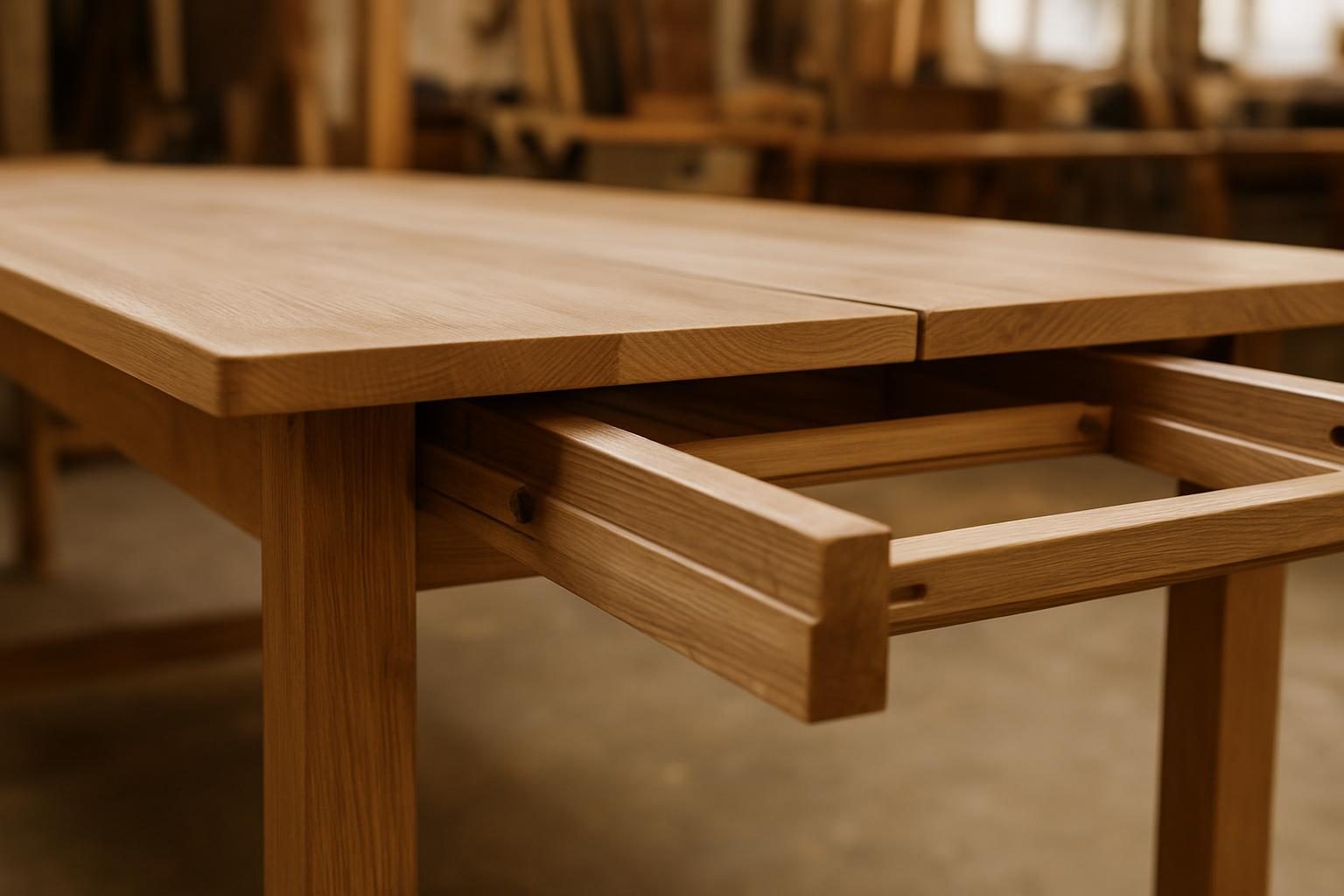
    Close-up of a table leaf joint and slide rails under a solid wood dining table top

    Sizes and Seating When Extended

    The goal is a comfortable closed size and a generous open size. Plan roughly 24 inches of table length per person for elbow room, and 12 to 14 inches less per person if you are using a bench on one side. Here are typical numbers for a 40 to 42 inch wide farmhouse top.

    • Closed 72 in., one 18 in. leaf: seats 6 closed, 8 open (90 in.)
    • Closed 84 in., two 18 in. leaves: seats 6 to 8 closed, 10 to 12 open (120 in.)
    • Closed 96 in., one 24 in. leaf: seats 8 closed, 10 to 12 open (120 in.)

    For the full breakdown of how many people fit at each length, see what size dining table seats 8, 6 and 10. Remember that the extended length is the number that has to fit your room, not the closed one.

    What It Costs

    A custom solid wood dining table starts at $2,200 in our shop, and an extension system is an add-on to that base price. For a farmhouse-style table with one or two leaves, expect to add roughly 15 to 30 percent, depending on the system and species. Slide rails with heavy-duty steel hardware sit at the higher end, while simple drop-in leaves sit at the lower end.

    The extra cost goes into three things: additional lumber for the leaves (cut from the same boards as the top), the rails or hardware, and the extra labor of fitting and flattening each leaf so it sits dead flush. We lay out the full range of what drives price in how much a custom dining table costs.

    The cheapest extension is the one you use twice a year, and it should be built so that it still works on the second try.

    What to Check Before You Commission

    Extensions are where cheaper tables cut corners, so it pays to ask specific questions. A few of these will tell you quickly whether a builder has made an extendable table before.

    • What are the slides or rails made of, and can they be replaced without rebuilding the table?
    • Are the leaves cut from the same boards as the top?
    • How are the leaves aligned and held in place?
    • How much do leaves weigh, and where will they be stored?
    • Does the table stay stable and level when fully extended, with legs or a support under the middle?
    Shop tip: Put painter’s tape on the floor at your full extended size, then walk around it with a chair pulled out. If you cannot get past comfortably, you have 36 inches of clearance to find or a shorter extension to choose.
    Solid wood table leaves stacked flat on a workbench in a small woodshop

    Species, Finish and Care

    Species matters more on a table that moves. White oak is stable and hard (Janka 1,360) and handles the seasonal swing well, especially when quartersawn. Walnut (1,010) is a little softer but just as steady, and both are covered in our walnut vs white oak comparison. You can browse the full species list in our wood guide.

    For finish, a hardwax oil is easier to touch up where leaves and the center seam see the most wear. The joint line between the leaf and the top is where crumbs, spills and wear collect, so keep it wiped and waxed. Our guide to hardwax oil vs polyurethane explains the tradeoffs.

    Is an Extendable Table Right for You?

    If you host more than a few times a year, an extendable top is worth it. If you only need extra seating once or twice, a fixed top at your largest size, or a bench added at the end, may be simpler and more durable. A well-sized fixed table has no moving parts to fail.

    If you do want to extend, start with the room. Measure it at full length, pick the system that matches how often you will use it, and settle the leaf storage before you settle the wood. Our guide to measuring your dining room walks through that step by step. We build and deliver across Jacksonville and Onslow County, including Hubert, Swansboro, Sneads Ferry and Richlands, and you can see the range on our custom dining tables page.

    FAQ

    How much extra does an extendable dining table cost?

    On a custom solid wood table, expect roughly 15 to 30 percent over the same fixed-top table. Simple drop-in leaves cost the least. Slide rails with steel hardware cost the most, and bigger or multiple leaves add lumber and fitting time.

    Do solid wood leaves match the rest of the table?

    They should if they are cut from the same boards as the top. Color and grain carry across the seam. Over years, a leaf that is stored away will age differently from the exposed top, so rotate leaves in occasionally if you can.

    Can an extendable table stay stable at full length?

    Yes, if it is built for it. Long extended spans need a stiff top, solid rails, and often a support leg or stretcher that deploys under the middle. Ask how the table is supported at full extension before you order.

    If you are weighing an extendable top for your own dining room, you can request a quote at /commission/.
  • Rustic Dining Tables: Woods, Finishes and What to Look For

    Rustic Dining Tables: Woods, Finishes and What to Look For

    “Rustic” gets stamped on everything from imported pine tables to hand-built hardwood. The word itself isn’t a quality marker, so it helps to know what’s underneath the look. A good rustic dining table is solid wood with honest character: knots, grain movement, tight joinery and a finish that wears in rather than wears out.

    This guide covers the woods that suit the style, what the character marks mean, which finishes make sense, and the construction details that separate a table that lasts from one that cracks in its second winter.

    The short version

    • Rustic is a look, not a material. Real rustic comes from solid hardwood with natural character, not from spray-on distressing.
    • White oak, hickory and walnut all work. Oak and hickory are harder; walnut is softer but richer in color.
    • Knots, mineral streaks and small checks are fine when stabilized. Open cracks and loose knots are not.
    • Hardwax oil gives the most natural, repairable surface. Polyurethane resists spills better but is harder to touch up.
    • Breadboard ends, thick tops and proper joinery matter more than any finish.

    What “Rustic” Actually Means in a Dining Table

    Rustic design leans on the wood’s natural character: visible grain, knots, color variation and a slightly textured, hand-built feel. It’s a counterpoint to polished, high-gloss modern furniture. The best examples look like they belong in a farmhouse kitchen because the material itself earns it.

    What it should not mean is cheap or fragile. Plenty of “rustic” tables are built from thin veneered panels or low-grade softwood and then beaten with chains to fake age. That’s distressing applied to a weak table, and it will not improve with time.

    A genuinely rustic solid wood table has a top 1.5 to 2 inches thick, edges that are softened but not gouged, and character that comes from the board rather than from a tool. If you want the full case for real wood over faced panels, our post on solid wood vs veneer furniture breaks down what you’re paying for.

    The Best Woods for a Rustic Dining Table

    Species choice sets the color, the grain pattern and how well the top handles daily use. Janka hardness is a useful yardstick for dent resistance: the higher the number, the harder the wood. Here’s how the common rustic candidates compare.

    SpeciesJanka (lbf)LookBest for
    White oak1,360Light tan to brown, open grain, ray fleck in quartersawnClassic farmhouse feel, heavy daily use
    Hickory1,820Strong contrast between pale and dark boardsMaximum rustic character, very dent resistant
    Black walnut1,010Chocolate brown with purple and gray tonesWarm, upscale rustic
    Hard maple1,450Pale, fine grain, little variationCleaner, lighter look; shows knots less
    Eastern white pine380Pale yellow, knotty, darkens with ageBudget rustic; dents and scratches easily

    Pine is the traditional rustic choice and it looks great, but at 380 on the Janka scale it will show every dropped fork. For a family table that gets used daily, oak, hickory or walnut are better bets. If you’re torn between the two most popular choices, we compared them directly in walnut vs white oak for a dining table, and the wood guide lays out the rest of the species we build with.

    Character is welcome in a rustic table; weakness is not.

    Close-up of a hickory tabletop showing contrast between pale sapwood and dark heartwood with a sound knot

    Knots, Checks and Grain: Character vs Defects

    Rustic buyers want to see the tree in the table, but not every mark is equal. Learning to tell the difference will save you from a bad purchase. Some features are cosmetic and stable; others are structural problems waiting to open up.

    • Tight knots: solid, flush with the surface and fully attached to the surrounding wood. Perfectly fine and a big part of the look.
    • Loose or hollow knots: these can fall out or leave voids. They should be filled and stabilized, usually with epoxy or a color-matched fill, or avoided in high-use areas.
    • Mineral streaks: dark gray or olive lines caused by minerals in the tree. Harmless and often beautiful in maple and oak.
    • Small surface checks: hairline cracks along the grain, common in drying hardwood. Acceptable when stable and filled; a wide or growing crack is a defect.
    • Wane and bark inclusions: irregular edges or trapped bark. Fine for a deliberate live-edge piece, but they need to be sound.
    • Sapwood contrast: pale strips beside darker heartwood. A signature rustic feature, especially in walnut and hickory.

    A reputable builder will point these out and explain how they’re handled. If you want to understand why cracks happen in the first place and how they’re prevented, read why solid wood furniture cracks.

    Choosing a Finish for a Rustic Table

    The finish controls how the table looks, how it handles spills and how you’ll repair it years from now. For rustic styles, the goal is usually a natural, low-sheen surface that lets the grain show. The two main options trade ease of care against durability.

    Hardwax oil soaks into the wood and leaves a matte, tactile surface. Scratches and water marks can be sanded out and spot-recoated without refinishing the whole top. Polyurethane builds a film on the surface that shrugs off spills, but when it chips or wears through you generally have to strip the whole top to fix it.

    For a table that will see kids, homework and hot dishes, either can work if you’re consistent with care. We go deeper in hardwax oil vs polyurethane, and once you’ve chosen, how to care for a solid wood dining table covers the day-to-day routine.

    Shop tip: Ask for a finished sample board in the exact species and finish you’re considering. Stains and oils look different on every board, and a 12-inch sample tells you more than any photo.

    The finish you can repair is usually better than the finish that’s tougher on day one.

    Breadboard end and mortise-and-tenon joinery detail on a thick solid wood farm table in a small woodshop

    Construction Details That Decide How Long It Lasts

    Wood moves with humidity, swelling across the grain in summer and shrinking in winter. A table built without allowing for that movement will crack, cup or split a joint. This matters in coastal North Carolina, where humidity swings are real and a poorly built top can show it within a year or two.

    Look for a top at least 1.5 inches thick, with boards glued edge to edge and the grain oriented to resist cupping. Breadboard ends keep a wide top flat while letting it expand and contract, which is why they appear on well-built farm tables; see breadboard ends and why good tables have them.

    Check the base too. Mortise-and-tenon joints, rather than screws alone, hold up under years of chairs bumping and people leaning. A trestle or leg design changes legroom and seating, so compare them in trestle base vs four legs.

    Sizing and Budget

    Most rustic dining tables run 36 to 42 inches wide and 30 inches tall, with length set by how many people you seat. As a rough guide, a 72-inch table seats six and an 84 to 96-inch table seats eight, but your room decides the final number. Measure first, and use what size dining table seats 8 and how to measure your dining room to plan clearance.

    Our custom dining tables start at $2,200, with the final price driven by species, length, thickness and base. Hickory and oak sit toward the lower end of that range; walnut and longer tables climb from there. For a fuller breakdown, see how much a custom dining table costs. We build a few commissions a month and deliver or arrange pickup around Jacksonville and the rest of Onslow County, including Hubert, Swansboro, Sneads Ferry and Richlands.

    If you want to see the range of what we make, browse our custom dining tables, then read how a commission works for the steps from quote to delivery. Quotes are fixed, with a 50% deposit to start.

    FAQ

    What is the best wood for a rustic dining table?

    White oak and hickory are the strongest all-around choices, with Janka ratings of 1,360 and 1,820. They resist dents, show pronounced grain and take finish well. Walnut is a softer but richer-looking option if you prefer a darker, warmer table.

    Are knots and cracks in a rustic table a problem?

    Tight, stable knots and hairline surface checks are normal and part of the look. Loose knots, hollow voids and wide or spreading cracks are defects unless they’ve been properly filled and stabilized. Ask your builder how each feature is handled.

    Is a rustic dining table hard to maintain?

    Not really. Wipe spills promptly, use trivets under hot dishes, and refresh a hardwax oil finish once or twice a year if the surface looks dry. Scratches on an oiled table can usually be sanded and spot-treated without refinishing the whole top.

    If you’d like a rustic solid hardwood dining table built to your room and your budget, request a quote at /commission/.

  • Live Edge Coffee Table Guide: Slab Size, Height and Base Options

    Live Edge Coffee Table Guide: Slab Size, Height and Base Options

    A live edge coffee table keeps the natural outline of the tree along one or both long sides. No two are alike, which is the appeal, and also why sizing one takes more thought than ordering a standard rectangle. This guide covers the numbers that matter: slab length and width, thickness, finished height, base styles and what drives the price.

    The short version

    • Aim for a slab 44 to 54 inches long and 20 to 26 inches wide at its narrowest point.
    • Finished height should land 1 to 2 inches below your sofa seat, usually 15 to 18 inches.
    • Slab thickness of 1.75 to 2.5 inches looks substantial without feeling like a block.
    • Base choice changes the whole look: hairpin legs read light, a solid wood base reads grounded.
    • Our coffee tables start at $850; slab width, species and base complexity move the price.

    What “live edge” actually means

    The live edge is the outer surface of the tree, where the bark was. On a slab, it is the wavy, uneven side you see once the bark is removed. We strip the bark, clean and stabilize the edge, and finish it so it is smooth to the touch and won’t shed.

    A coffee table can have one live edge, two, or none. Two live edges give you the full organic outline and usually need a wider, more irregular slab. One live edge paired with a straight cut side is easier to tuck against a wall or sofa and often a better fit for tighter rooms.

    Slab length and width

    Length first. A good rule is for the table to be about two thirds the length of your sofa. For an 84-inch sofa, that points to a table around 48 to 56 inches long. Our coffee table size guide walks through the sofa-to-table math in more detail.

    Width is where live edge gets interesting, because the slab is not a constant width. Check the narrowest point, not the widest. If one end of the slab bulges to 30 inches but the middle pinches to 16, your knees and your drink placement are governed by that 16.

    • Minimum comfortable width: 18 inches at the narrowest point.
    • Sweet spot: 20 to 26 inches for most living rooms.
    • Leave walking room: 14 to 18 inches between the table edge and the sofa.

    Measure a live edge slab at its narrowest point, because that is the width you will actually live with.

    Thickness and finished height

    Thickness is a proportion decision. A 1.5-inch slab looks refined on a light base. A 2.5-inch slab feels chunky and pairs better with a heavy solid wood base. Most of our coffee tables fall between 1.75 and 2.25 inches, which holds up well visually and is thick enough to stay flat.

    Finished height is slab thickness plus base height. A standard coffee table is 16 to 18 inches tall, and the best rule is to land 1 to 2 inches below your sofa seat cushion. If your sofa seat sits at 18 inches, aim for 16 to 17. Low modern sofas at 15 inches call for a table closer to 14 or 15.

    Close-up of a live edge slab showing grain, sapwood and finished edge

    Base options and how they change the look

    The base is half the design. The same slab can look airy or monumental depending on what holds it up.

    Base styleLookBest forNotes
    Steel hairpin legsLight, mid-centurySmaller rooms, thin slabsLeast expensive; fine under 2 inches thick
    Square steel or flat bar frameModern, cleanContemporary roomsCarries heavier slabs well
    Solid wood legsWarm, traditionalMost living roomsMatches or contrasts with the slab
    Solid wood trestle or slab baseGrounded, substantialThick slabs, large roomsHeaviest option; see our trestle vs legs comparison for how bases feel in a room

    One practical point: live edge slabs move with the seasons, so the base should let the top expand and contract. Fixed, rigid fastening is how tops end up cracking. We attach tops with fasteners that allow movement, which is the same reason we explain why solid wood furniture cracks and how it is prevented.

    The slab gets the attention, but the base decides whether the table feels light or heavy in your room.

    Choosing a species

    Species sets the color, the grain and how the table wears. Walnut is the classic live edge choice: dark chocolate heartwood with lighter sapwood along the edge, and a Janka hardness around 1,010 lbf. White oak runs lighter and harder at about 1,360 lbf, with a tougher surface for a table that gets daily use.

    Maple (around 1,450 lbf) is hard and pale, and it shows figure well but has less dramatic edge contrast. Cherry (about 950 lbf) darkens beautifully with age but is softer. Our wood guide compares the options side by side, and the walnut versus oak trade-offs in our walnut vs white oak post apply to coffee tables too.

    Live edge slab clamped on a workbench in a small woodshop with hand planes nearby

    Cracks, checks and what is normal

    Live edge slabs often have character: small checks, knots, bark inclusions and the occasional void. Some of this is the point. The key question is whether a feature is stable and sound or whether it is a structural weakness.

    We fill voids and stabilize checks where it makes sense, and we flatten and finish the surface so a glass sits level. Butterfly keys (small bowtie inlays) can lock a crack from spreading and double as a design detail. If a slab has a defect we think will not hold, we will say so before we cut, not after.

    Shop tip: Put a cup on the slab and a ruler across it before you commit. A live edge top that rocks or has a dip where your drinks go will annoy you every day, so ask for a flat, finished surface and test it in person if you can.

    Finish and everyday care

    A coffee table gets more spills, coasters-skipped moments and set-down keys than a dining table gets plates. For that reason we like a finish that is easy to maintain. Hardwax oil is simple to spot-repair; polyurethane gives a harder film that resists water longer. Our hardwax oil vs polyurethane comparison covers the choice in detail.

    Whichever you pick, wipe spills promptly and use coasters for hot mugs. If a white ring does show up, our guide to removing water rings from a wood table will help.

    What a live edge coffee table costs

    Our coffee tables start at $850. A table at the low end is typically a more modest slab on a simple base. Price climbs with slab width and figure, thickness, species, the complexity of the base, and extras like butterfly keys or a two-live-edge outline. Every commission gets a fixed quote and a 50% deposit, so the number you agree to is the number you pay.

    If you are in Jacksonville or elsewhere in Onslow County, including Hubert, Swansboro, Sneads Ferry and Richlands, we can handle local pickup or delivery. You can see the range on our coffee tables page and how the build runs on the process page.

    FAQ

    How thick should a live edge coffee table slab be?

    Between 1.75 and 2.5 inches suits most rooms. Thinner slabs look lighter on hairpin or steel legs, while thicker slabs pair better with a solid wood base and larger spaces.

    What height should a live edge coffee table be?

    Most land between 15 and 18 inches. The best target is 1 to 2 inches lower than your sofa seat so the table is easy to reach without feeling like you are reaching down into it.

    Will a live edge coffee table crack?

    Solid wood moves with humidity, and small surface checks can appear in any slab. Proper drying, a base that lets the top move, and stabilized checks keep it sound for decades. Read more in our post on solid wood versus veneer furniture.

    If you would like a live edge coffee table sized to your sofa and room, request a quote and we will start from your measurements.