
The short version
- Three common systems: drop-in leaves, slide-out rails with leaves, and butterfly leaves stored under the top.
- Expect a custom extendable table to cost roughly 15 to 30 percent more than the same fixed-top table, and more for heavy-duty hardware.
- Leaves should come from the same boards as the top so grain and color match, and they need to move with the seasons like everything else.
- Measure the room at full extension, not just closed, and leave 36 to 42 inches of clearance around the table.
- Rail and slide hardware is the part that wears out first. Ask what it is and whether it can be replaced.
A farmhouse table is built to be the center of the house, and most households need it to flex. Six people most nights, ten or twelve a few times a year. An extendable farmhouse dining table solves that, but it adds moving parts to a piece of furniture whose whole appeal is being solid and simple.
This is a plain look at how extensions work, what they do to price and construction, and what to check before you commit to one.
How Extendable Dining Tables Work
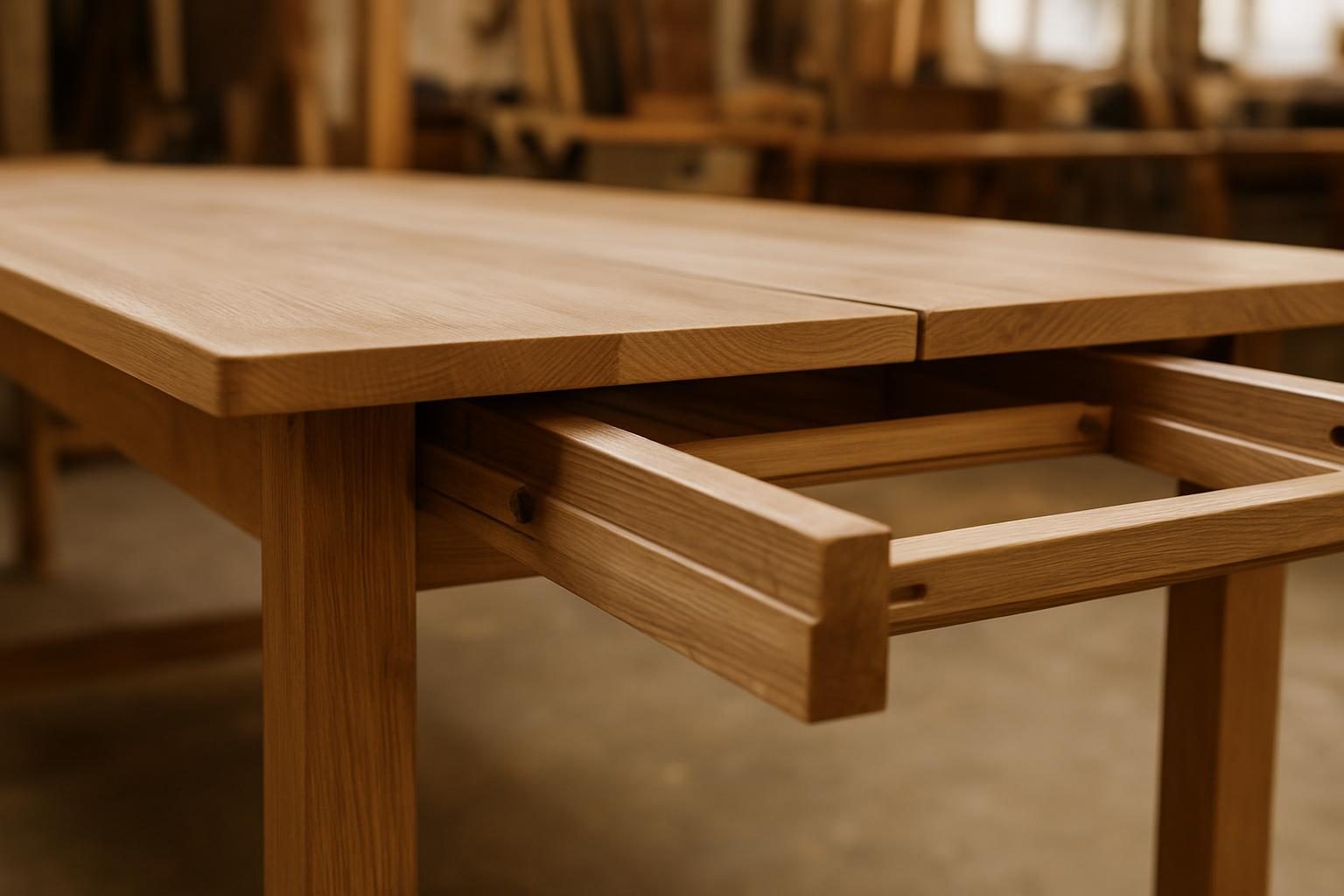
There are three systems you will run into, and they behave very differently in daily use. The right one depends on how often you extend the table and how much storage space you have for loose leaves.
| System | How it works | Typical gain | Best for |
|---|---|---|---|
| Drop-in leaves | Top separates or slides apart; loose leaves drop into the gap, held by pins or clips | 12 to 24 in. per leaf | Occasional use, simplest mechanism |
| Slide rails | Two table halves ride on wood or steel rails; leaves go between them | 18 to 48 in. total | Frequent use, large extensions |
| Butterfly leaf | Leaf folds in half and stores in a pocket under the top | 18 to 24 in. | Households with no closet space for leaves |
Drop-in leaves are the most forgiving. There is little to jam or wear out, and a top that separates in the middle is easy to repair. The tradeoff is that you need somewhere flat and safe to store the leaves, since a 40 inch leaf leaning against a garage wall will warp.
Farmhouse Style and Extensions: What Fits
Farmhouse tables tend to have thick tops, chunky legs or a trestle base, and a plain apron. That heft works for and against extensions. A 1.75 inch thick top is stable and handsome, but it also means each leaf is heavy, often 25 to 40 pounds, which matters if you are the one lifting it.
The base matters too. A four-leg table with a full apron has to carry the slide mechanism inside the apron, so the apron needs to be deep enough to hide it. A trestle base with a stretcher can make extension harder, because the stretcher is often exactly where the rails want to go. If you are choosing between the two, our comparison of trestle base vs four legs covers the leg room and seating tradeoffs.
A table that opens smoothly in year one and still opens smoothly in year ten is mostly a hardware and wood-movement problem, not a styling one.
Solid Wood Movement and Leaves
Solid wood expands and contracts across the grain with humidity. On a 42 inch wide top, that can be 1/4 inch or more between a humid Onslow County August and a dry heated January. A fixed top handles this with the right fastening, and a leaf has to handle it too.
The usual fix is to cut leaves from the same boards as the top, in sequence, so grain and color carry across the seam. Leaves are then fitted with a small, deliberate gap or aligned with pins and a slight float, so they do not bind when the top swells. A tight table in January can become a stuck table in July. We go deeper on the underlying behavior in why solid wood furniture cracks, and on how long boards stay flat in breadboard ends: what they are.
Sizes and Seating When Extended
The goal is a comfortable closed size and a generous open size. Plan roughly 24 inches of table length per person for elbow room, and 12 to 14 inches less per person if you are using a bench on one side. Here are typical numbers for a 40 to 42 inch wide farmhouse top.
- Closed 72 in., one 18 in. leaf: seats 6 closed, 8 open (90 in.)
- Closed 84 in., two 18 in. leaves: seats 6 to 8 closed, 10 to 12 open (120 in.)
- Closed 96 in., one 24 in. leaf: seats 8 closed, 10 to 12 open (120 in.)
For the full breakdown of how many people fit at each length, see what size dining table seats 8, 6 and 10. Remember that the extended length is the number that has to fit your room, not the closed one.
What It Costs
A custom solid wood dining table starts at $2,200 in our shop, and an extension system is an add-on to that base price. For a farmhouse-style table with one or two leaves, expect to add roughly 15 to 30 percent, depending on the system and species. Slide rails with heavy-duty steel hardware sit at the higher end, while simple drop-in leaves sit at the lower end.
The extra cost goes into three things: additional lumber for the leaves (cut from the same boards as the top), the rails or hardware, and the extra labor of fitting and flattening each leaf so it sits dead flush. We lay out the full range of what drives price in how much a custom dining table costs.
The cheapest extension is the one you use twice a year, and it should be built so that it still works on the second try.
What to Check Before You Commission
Extensions are where cheaper tables cut corners, so it pays to ask specific questions. A few of these will tell you quickly whether a builder has made an extendable table before.
- What are the slides or rails made of, and can they be replaced without rebuilding the table?
- Are the leaves cut from the same boards as the top?
- How are the leaves aligned and held in place?
- How much do leaves weigh, and where will they be stored?
- Does the table stay stable and level when fully extended, with legs or a support under the middle?
Species, Finish and Care
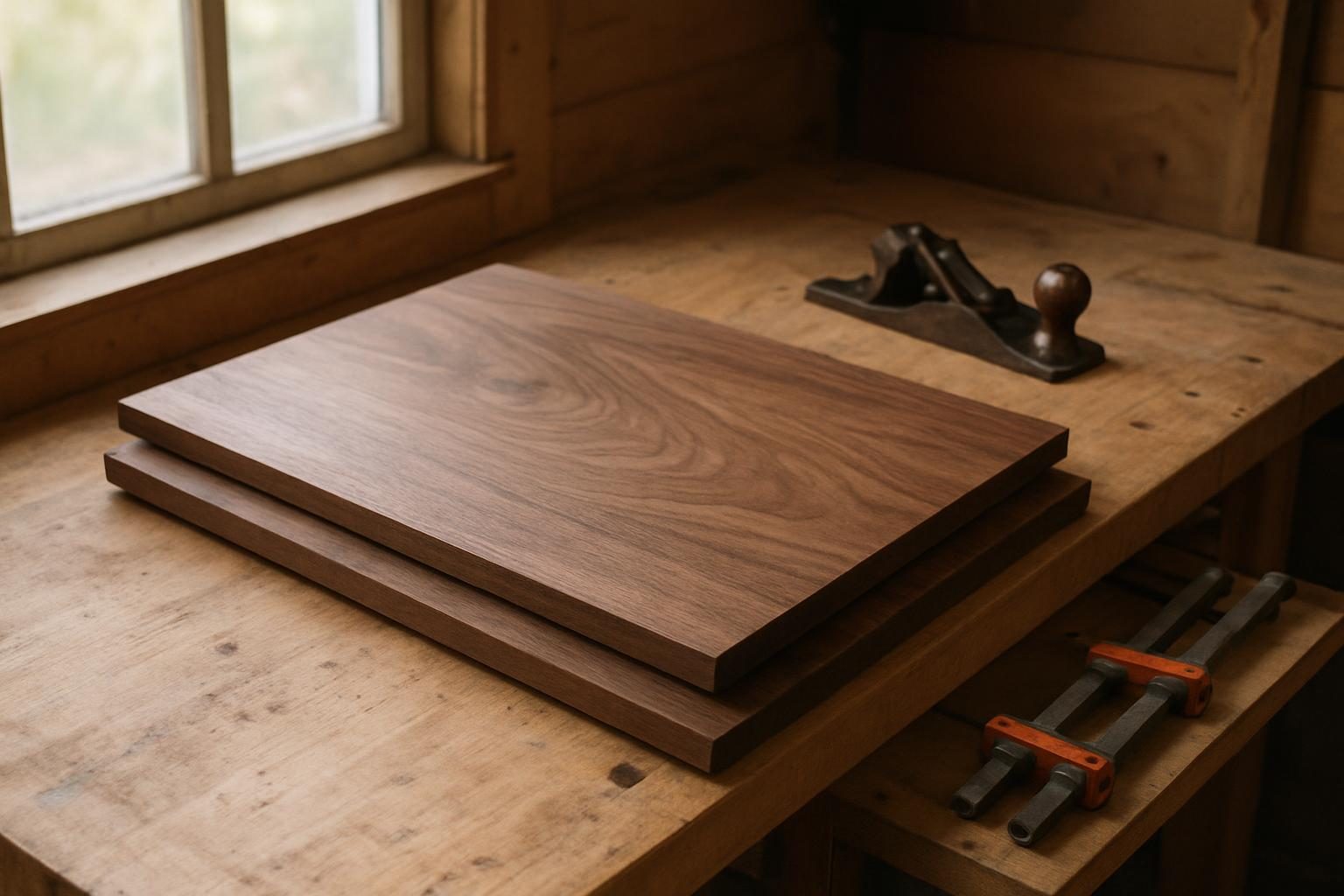
Species matters more on a table that moves. White oak is stable and hard (Janka 1,360) and handles the seasonal swing well, especially when quartersawn. Walnut (1,010) is a little softer but just as steady, and both are covered in our walnut vs white oak comparison. You can browse the full species list in our wood guide.
For finish, a hardwax oil is easier to touch up where leaves and the center seam see the most wear. The joint line between the leaf and the top is where crumbs, spills and wear collect, so keep it wiped and waxed. Our guide to hardwax oil vs polyurethane explains the tradeoffs.
Is an Extendable Table Right for You?
If you host more than a few times a year, an extendable top is worth it. If you only need extra seating once or twice, a fixed top at your largest size, or a bench added at the end, may be simpler and more durable. A well-sized fixed table has no moving parts to fail.
If you do want to extend, start with the room. Measure it at full length, pick the system that matches how often you will use it, and settle the leaf storage before you settle the wood. Our guide to measuring your dining room walks through that step by step. We build and deliver across Jacksonville and Onslow County, including Hubert, Swansboro, Sneads Ferry and Richlands, and you can see the range on our custom dining tables page.
FAQ
How much extra does an extendable dining table cost?
On a custom solid wood table, expect roughly 15 to 30 percent over the same fixed-top table. Simple drop-in leaves cost the least. Slide rails with steel hardware cost the most, and bigger or multiple leaves add lumber and fitting time.
Do solid wood leaves match the rest of the table?
They should if they are cut from the same boards as the top. Color and grain carry across the seam. Over years, a leaf that is stored away will age differently from the exposed top, so rotate leaves in occasionally if you can.
Can an extendable table stay stable at full length?
Yes, if it is built for it. Long extended spans need a stiff top, solid rails, and often a support leg or stretcher that deploys under the middle. Ask how the table is supported at full extension before you order.
If you are weighing an extendable top for your own dining room, you can request a quote at /commission/.