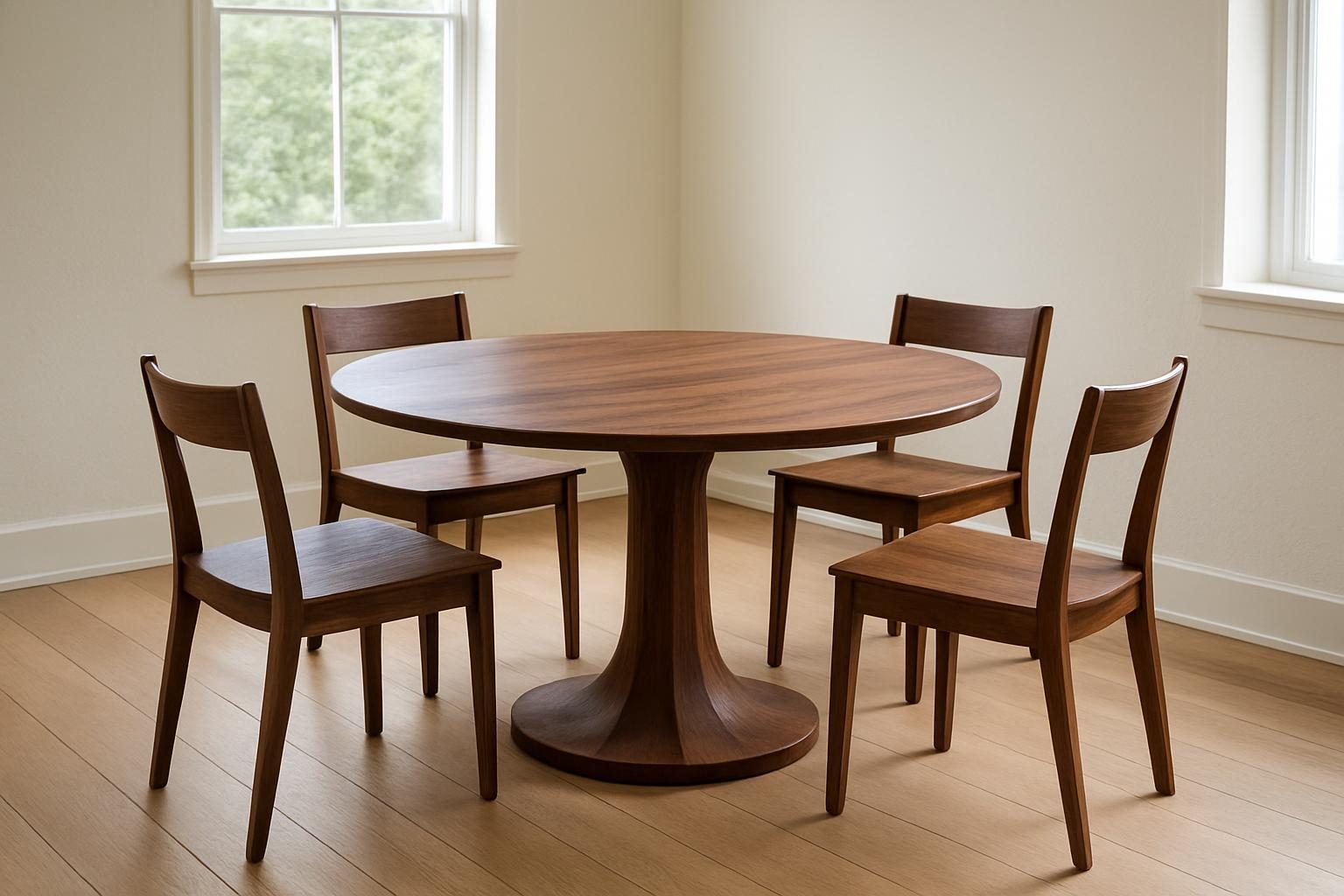
Most people pick a table shape by looking at photos. The better way is to look at your floor plan, because the shape of the room and the way people walk through it will decide this for you faster than taste will.
I build both, and neither is better in the abstract. A round table in the wrong room is as frustrating as a long rectangle crammed into a square one. Here’s how to match the shape to the space.
The short version
- Square or nearly square rooms usually suit round tables; long, narrow rooms suit rectangles.
- A 48″ round seats 4 comfortably and a 60″ round seats 6, but rounds get awkward past about 66″.
- Rectangles scale better for 8 or more and for rooms where the table doubles as a work surface.
- Plan for 36″ of clearance between the table edge and the nearest wall or furniture, 42″ or more where people walk behind chairs.
- A round table of the same seating capacity usually costs a bit less in material but more in shop time, so the price gap is small.
Start With the Room, Not the Table
A table is a shape sitting inside another shape. If the room is roughly square, a round table keeps the proportions balanced and leaves even space on all sides. If the room is long and narrow, a rectangle follows the room’s lines and leaves a clear path down one side.
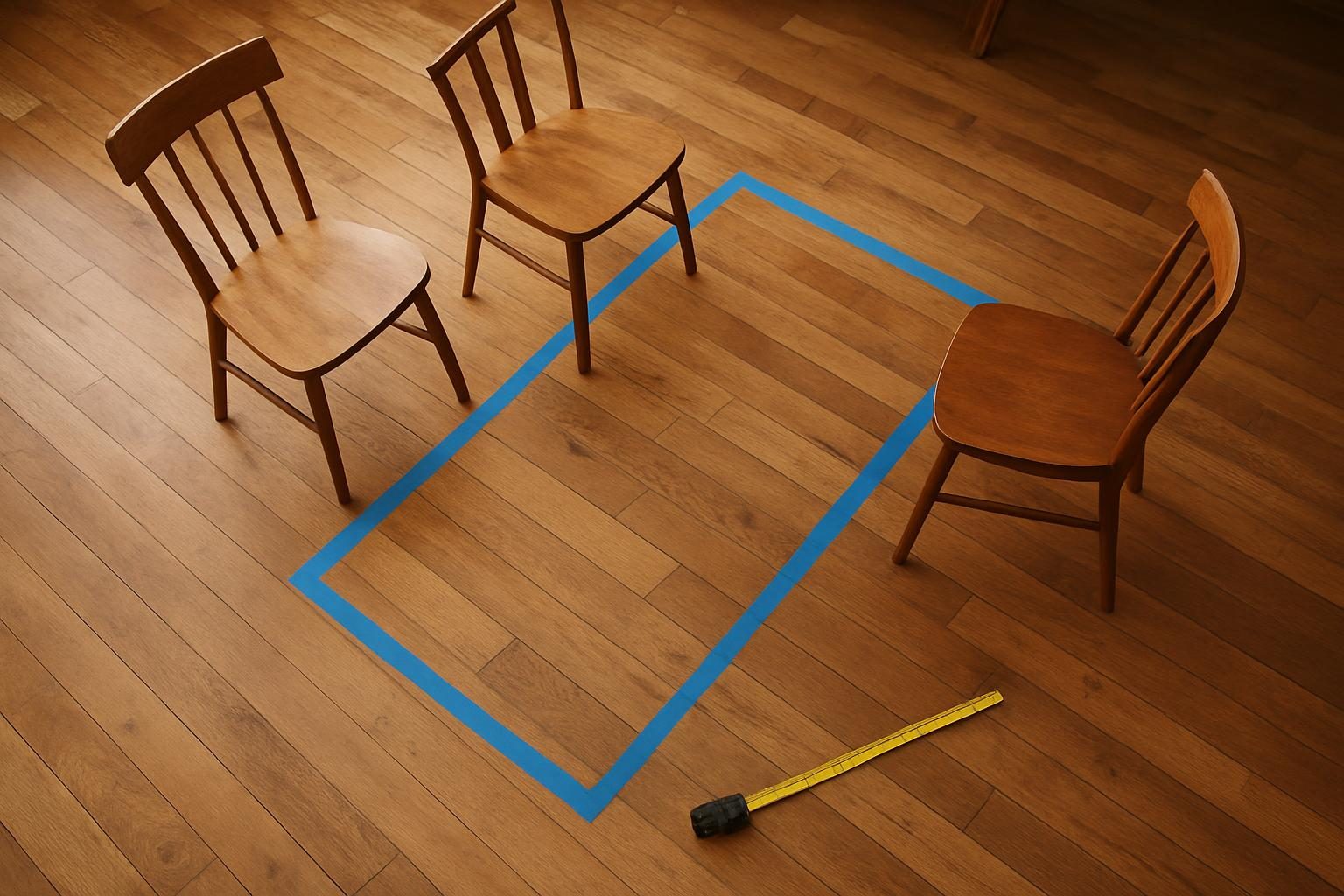
The room also tells you how much table you can afford. A 12′ x 12′ room fits a 54″ to 60″ round with good clearance. The same room with a 72″ x 38″ rectangle works, but the corners of the room get tight. Measure first, and our guide to measuring your dining room for a table walks through exactly how.
Openings matter too. Note where doors swing, where the hallway enters, and whether there’s a sliding door or a kitchen pass-through. A rectangle’s long side can block a doorway in a way a round table’s curve often doesn’t.
Measure the room before you fall for a photo.
Seating: What Each Shape Really Holds
Seat counts are where round tables get oversold. A round table seats people shoulder to shoulder around a curve, so every extra person pushes the diameter up fast. A rectangle adds seats in a straight line, so capacity grows more predictably.
| Seats | Round (diameter) | Rectangular (length x width) |
|---|---|---|
| 2 to 4 | 42″ to 48″ | 48″ x 32″ to 60″ x 34″ |
| 4 to 6 | 54″ to 60″ | 66″ x 36″ to 72″ x 38″ |
| 6 to 8 | 66″ (a stretch) | 84″ x 38″ to 96″ x 40″ |
| 8 to 10 | Not practical | 96″ x 40″ to 108″ x 42″ |
Those are comfortable sizes, not cram-it-in sizes. For a full breakdown by head count, see what size dining table seats 8, 6 and 10. The short story is that rounds top out around 66″ before the middle becomes too far to reach.
That reach is the hidden cost of a big round. At 72″, the center of the table is 36″ from every edge. Passing a dish across it takes a stretch, and a lazy Susan becomes a requirement rather than a nicety.
Flow and Walkways
How people move around the table matters as much as how many sit at it. The usual rule is 36″ from table edge to wall or furniture so a seated person can push back and others can still squeeze by. Where people regularly walk behind chairs, plan for 42″ to 48″.
- Round: no corners to catch a hip or a small child’s head, and traffic flows around the curve without a hard stop.
- Rectangular: corners project into the walkway, but you can push one long side close to a wall for daily use and pull it out when guests come.
- Either shape: a pedestal or trestle base frees the legs so chairs slide in from any side.
If your dining area opens straight into a kitchen or living room, think about sightlines too. A round table reads as a soft centerpiece, while a rectangle acts more like a divider, which can help or hurt depending on how open the plan is.
Clearance behind the chairs is what makes a table livable.
Conversation, Families, and How You Actually Eat
Round tables make everyone equal. Nobody sits at the head, and with four to six people you can talk to the whole table without raising your voice. For small families and frequent casual dinners, that closeness is the real selling point.
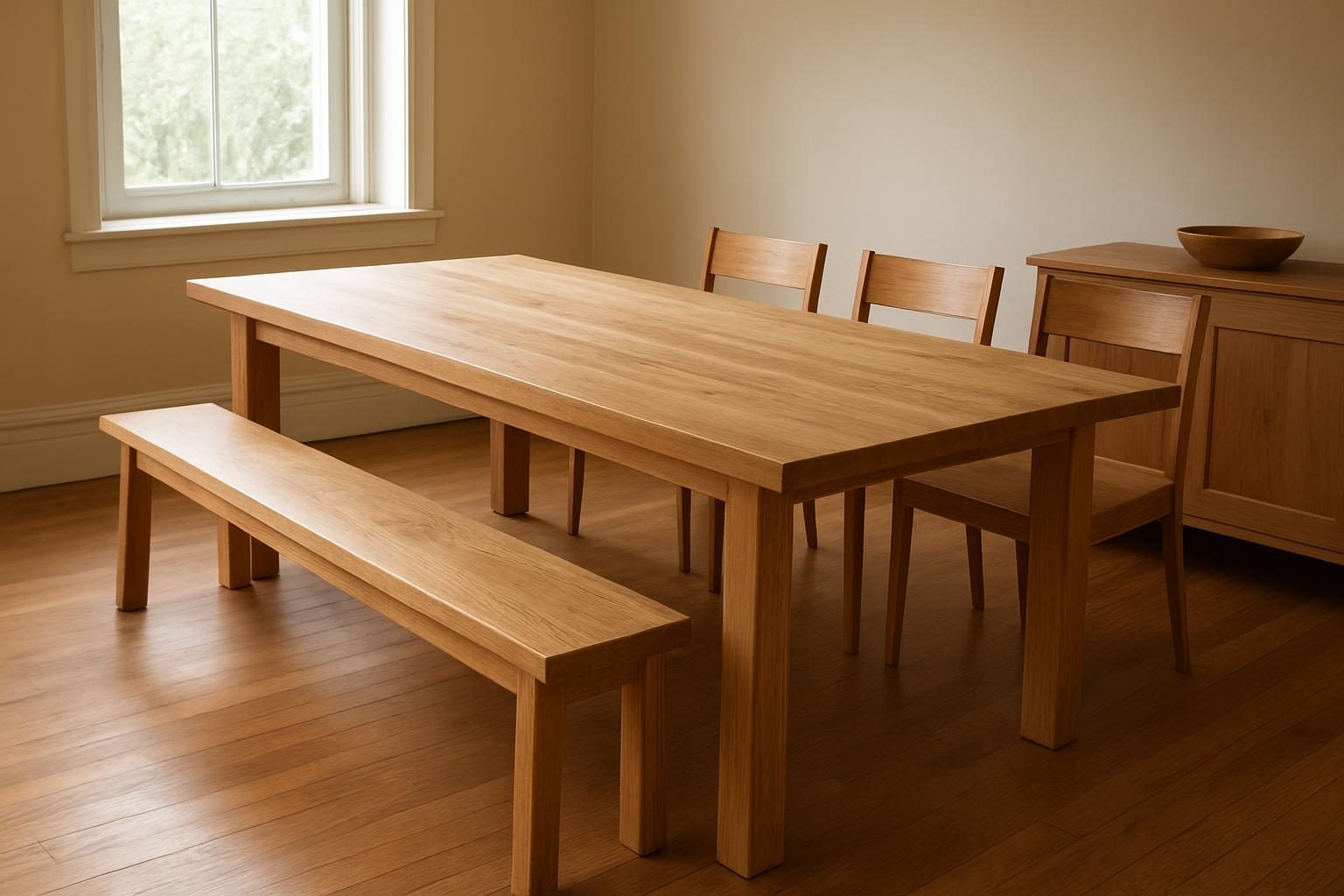
Rectangles suit bigger gatherings and mixed use. If the table is also the homework station, the place where you spread out paperwork, or the spot where you set out a buffet, you want that long, flat run. A rectangle also takes a bench along one side, which seats more people in less width. Our custom benches are built to pair with dining tables for exactly that.
Think about the guests you host, too. If it’s usually four to six people, a round is lovely. If it’s holiday dinners with ten, you’ll be glad for the length.
Wood, Build, and Cost
A round top glues up from boards like any other, but cutting a true circle takes extra shop time. Rounds also show end grain around part of the edge, so the species and finish matter. Grain tends to look best when the boards are laid out to follow the curve, and that takes careful selection.
Rectangular tops are simpler to build, and on a long solid top we often add breadboard ends to keep the boards flat through seasonal movement. Rounds handle that movement differently, since the wood moves across the grain the same way regardless of shape. Both need a base designed to let the top expand and contract.
On price, the gap between shapes is smaller than most people expect. Our custom dining tables start at $2,200, and size, species and base style move the number far more than round versus rectangular does. For the full picture, read how much a custom dining table costs.
So Which Should You Choose?
Choose a round table if your room is square or close to it, you usually seat four to six, and you want an easy, conversational feel. Choose a rectangle if your room is long, you seat eight or more, or you need the table to work as a big flat surface for more than meals.
If you’re torn, an oval or a rectangle with generous rounded corners splits the difference. You get the length for a crowd and softer edges for tight walkways. Either way, the species you pick shapes the look as much as the outline does, and the wood guide compares the hardwoods we work with.
We build and deliver to Jacksonville and the rest of Onslow County, including Hubert, Swansboro, Sneads Ferry and Richlands, so you can come see wood samples in person if you’re nearby. If you’d like to understand the steps from sketch to delivery, how a commission works lays it out.
Send us your room dimensions and head count and we’ll tell you which shape fits, and you can request a quote whenever you’re ready.
FAQ
Is a round or rectangular table better for a small dining room?
In a small, squarish room a round table, often 42″ to 48″, usually wins because it has no corners and leaves even clearance on every side. In a small but narrow room, a slim rectangle of around 30″ to 34″ wide can fit better against a wall. Measure the room and tape out the footprint to be sure.
How many people can sit at a 60-inch round table?
A 60″ round seats six comfortably, and some families squeeze in seven for a holiday. Beyond that, elbow room disappears and the center gets hard to reach. If you regularly host eight, a rectangle is the better tool.
Are round tables more expensive than rectangular ones?
Not by much. A round top takes extra shop time to cut and shape, but a rectangle of the same seating capacity uses more lumber, so the totals land close together. Size, species and base design affect the price far more than shape does.