The short version
- Epoxy river tables are a wood-and-resin composite. Solid live edge is one continuous piece (or a few glued boards) of hardwood with a natural edge.
- Epoxy looks dramatic and is easy to wipe down, but it scratches, scuffs and softens under heat, and it can’t be sanded back as freely as wood.
- Solid live edge is more repairable and ages gracefully, but it moves with humidity and needs a flat, stable slab.
- Epoxy costs more because of the resin, mold work and labor. Expect a meaningful premium over a comparable solid slab table.
What each table actually is
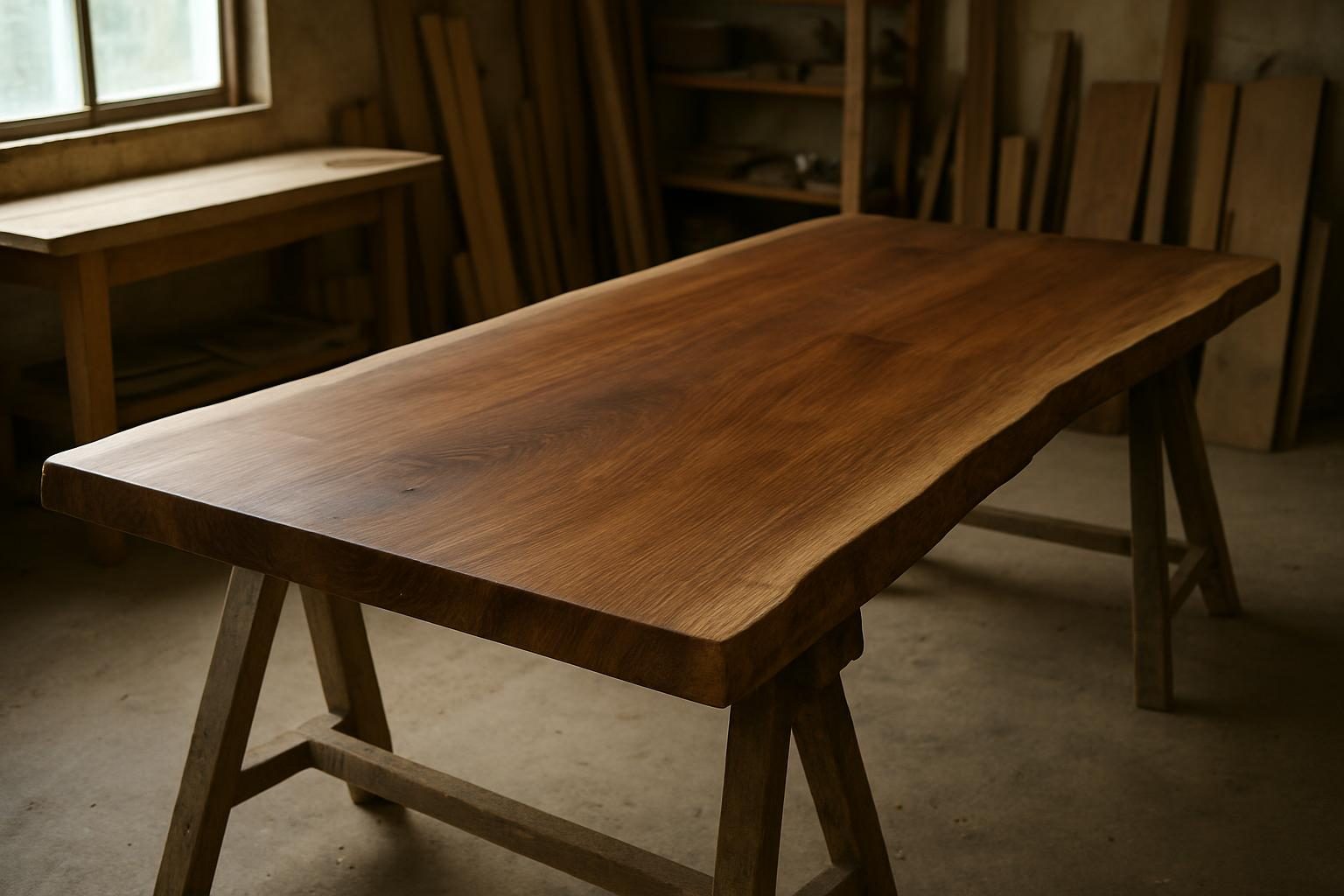
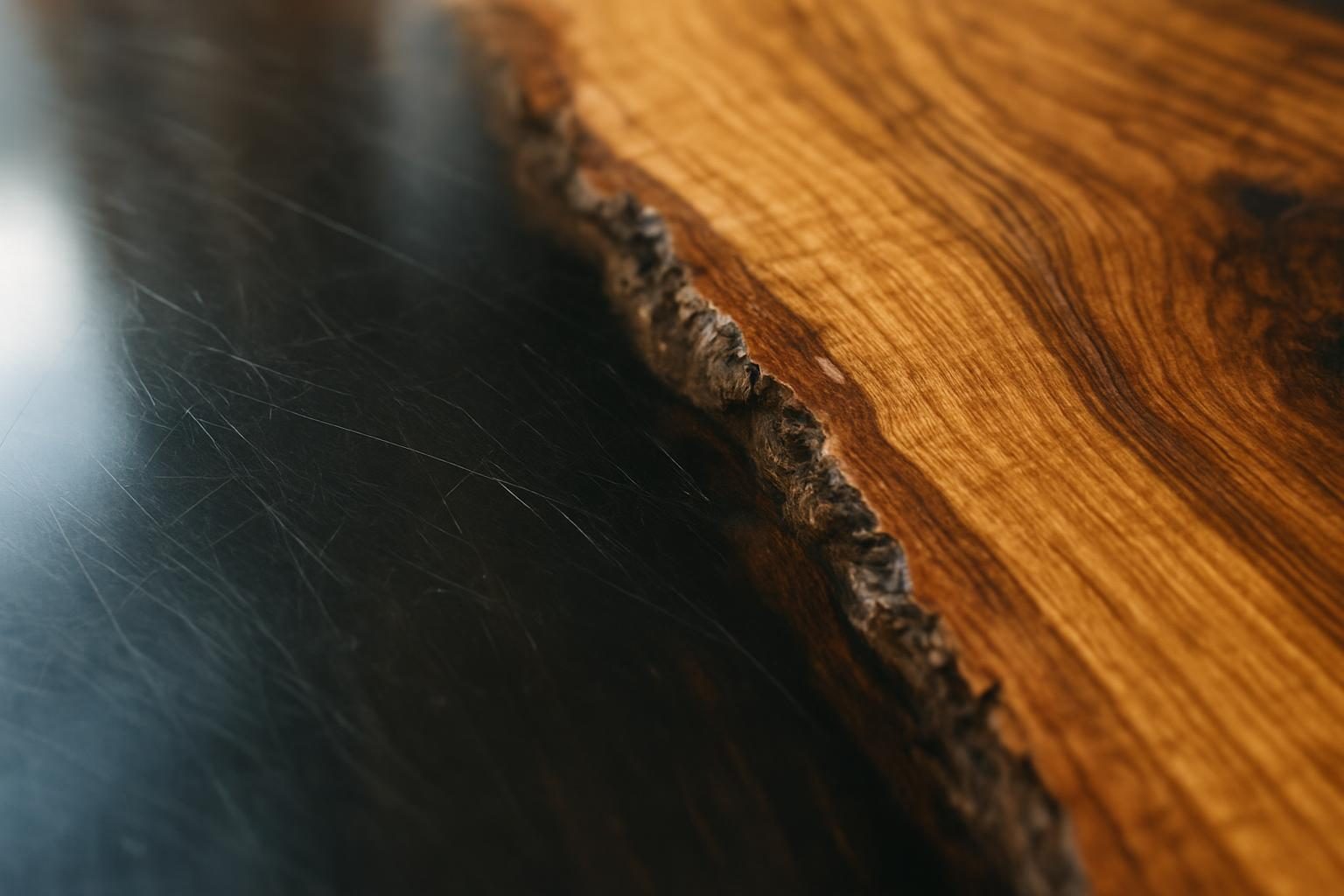
A solid live edge table is built from a hardwood slab (or two matched slabs) that keeps the natural contour of the tree on one or both long edges. The bark is removed, the edge is cleaned and sealed, and the top is flattened, sanded and finished. What you see is wood from edge to edge.
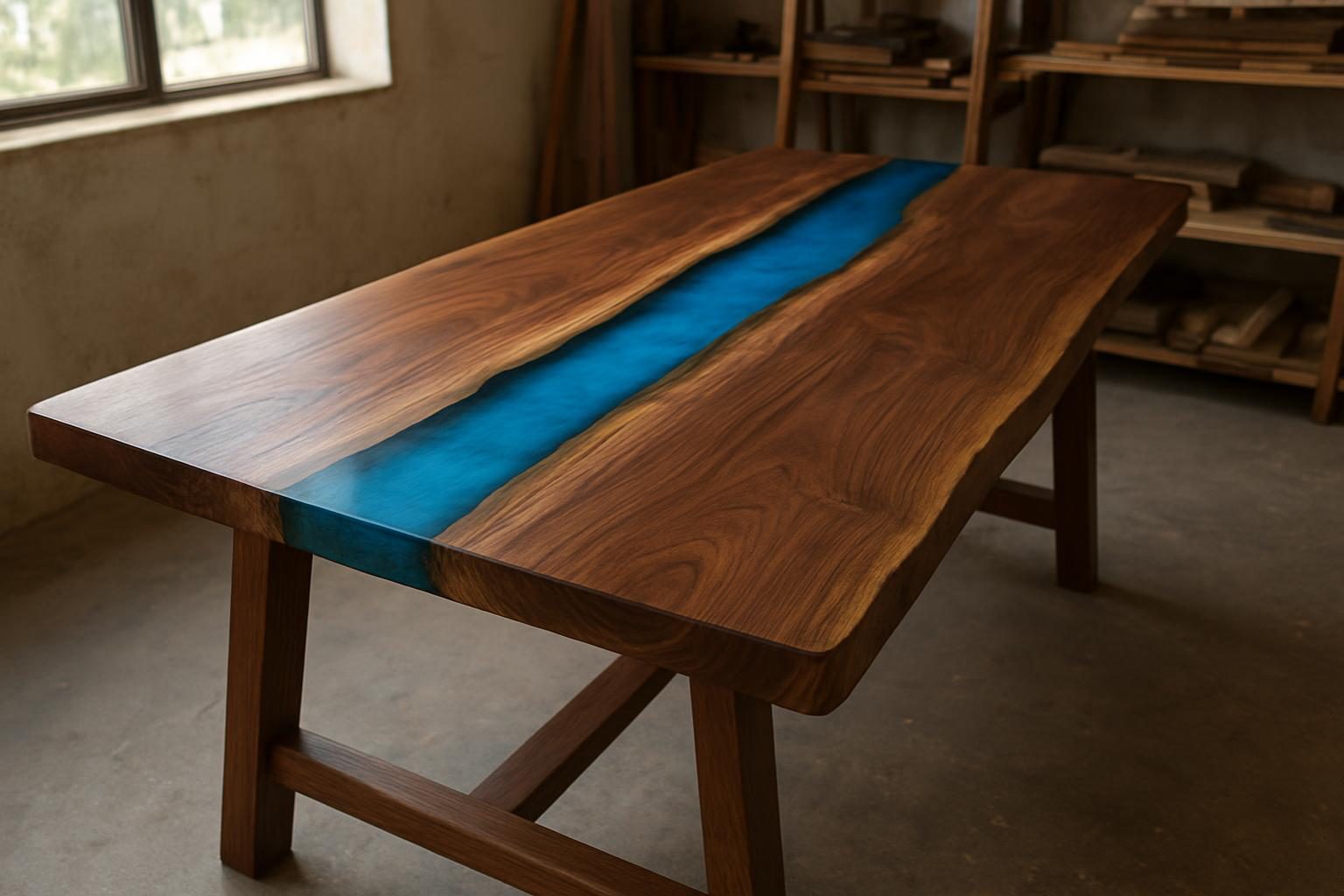
A live edge epoxy table, usually called a river table, starts with the same kind of slab but splits it into two halves. The halves are set apart in a mold, and the gap is filled with poured epoxy resin, often tinted blue, green or clear. The “river” is the resin channel running between the live edges.
Both can be beautiful. They just behave very differently once they are in a dining room or living room, which is what the rest of this post covers.
Durability: scratches, heat and daily wear
Cured epoxy is hard but not tough in the way people assume. It sits around Shore D 75 to 85 on the hardness scale, which resists dents but scratches readily and shows fine surface haze from plates, keys and laptop corners. Hardwoods like white oak (Janka around 1,360 lbf) and walnut (around 1,010 lbf) mark differently: they dent before they scratch, and the marks tend to hide in the grain.
Heat is the bigger difference. Most tabletop epoxies start to soften somewhere between 120 and 140 degrees Fahrenheit, and a hot pan or coffee pot can leave a permanent ring or cloudy spot in the resin. A solid wood top with a good finish handles brief heat better, though no finish is immune, and you should still use trivets either way.
UV is another factor. Many epoxies yellow or haze over the years with direct sun unless they include UV stabilizers, which are not a guarantee. A table by a west-facing window in Eastern North Carolina will see more of this than one in a shaded room.
Repairs and how each one ages
This is where solid wood wins most clearly. A scratch, ring or dull patch on a hardwax oil finish can usually be sanded out and re-oiled in an afternoon, and the table looks better afterward. Our post on hardwax oil vs polyurethane covers why the finish you choose changes how repairable a top is.
Epoxy is harder to fix. Light scratches can be buffed out, and shallow ones can be re-polished, but deep gouges mean sanding through the resin and recoating, and the repair is more likely to show. Chips along the resin-to-wood joint can let moisture creep under the edge over time.
Neither material lasts forever without attention. The difference is that a solid wood table can be refinished many times over decades, while an epoxy surface has a more limited number of good restorations.
Wood forgives a sanding block. Resin mostly doesn’t.
Wood movement: the part nobody mentions
Wood swells and shrinks across the grain as humidity changes. A wide slab can move a quarter inch or more over a year in a humid climate like coastal North Carolina. Epoxy does not move with it, so a poorly built river table can develop hairline cracks at the resin edge, or the slab can pull away from the pour.
Solid slabs handle this through good design: proper drying (kiln-dried to roughly 6 to 8 percent moisture), correct thickness, and a base or breadboard-style detail that lets the top move. We go into this in why solid wood furniture cracks, and the same principles apply to the wood halves of an epoxy table.
If you are considering a river table, ask how the wood was dried and how the epoxy was poured. Deep pours in a single go can overheat and cloud, so quality work is done in layers, and that is part of why the price climbs.
Cost: where the money goes
Epoxy tables cost more for good reasons: the resin itself is expensive, a deep pour for a dining-size table needs a lot of it, and the mold, layered pours, flattening and polishing all add labor. A table that would be a straightforward slab build gets a lot more shop time once resin is involved.
For reference, our solid hardwood dining tables start at $2,200, and a live edge build is priced from the slab, the size and the base. For the general cost picture, see how much a custom dining table costs.
| Factor | Epoxy river table | Solid live edge |
|---|---|---|
| Scratch resistance | Scratches and hazes easily | Marks hide in grain, sands out |
| Heat tolerance | Softens around 120-140 F | Better, still use trivets |
| Repairability | Limited, repairs can show | Re-sand and re-oil |
| Wood movement | Can stress the resin joint | Designed to move |
| Everyday wipe-down | Very easy | Easy with a good finish |
| Relative cost | Higher | Lower for same size |
Daily care for each
For an epoxy top, use a soft cloth with mild soap and water, avoid abrasive pads, and keep hot dishes and direct sun off the resin. Felt pads under everything are worth the trouble.
For solid live edge, wipe spills promptly, keep the top out of the path of heating vents, and re-oil a hardwax finish once or twice a year as it dulls. Our guides on caring for a solid wood table and removing water rings walk through the specifics.
Pick the table you are willing to care for, not just the one that photographs best.
Which one should you choose
Choose an epoxy river table if the color and the dramatic look are the point, you will be careful with it, and the budget is there. It makes a striking statement piece, and it suits a room where the table is the focal point.
Choose solid live edge if you want a top that handles real family use, can be refinished for decades, and lets the character of the wood do the talking. It is also the more economical route to the same natural-edge look, and it leaves budget for a better base. If you are leaning that way, our live edge coffee table guide shows how slab size and height play out in a smaller piece.
If you are near Jacksonville, NC, or anywhere in Onslow County, including Hubert, Swansboro, Sneads Ferry, Richlands and the Camp Lejeune area, we handle furniture pickup and delivery locally. Our commission process explains how quotes, deposits and builds work.
FAQ
Is an epoxy river table durable enough for a dining table?
It can work, but it is less forgiving than solid wood. Epoxy scratches more visibly and can soften under hot dishes, so a dining table that sees daily use needs trivets and placemats. A solid hardwood top is the lower-maintenance choice for a busy household.
Does epoxy yellow or crack over time?
Some epoxies yellow with sun exposure unless they contain UV stabilizers, and cracking usually comes from wood movement or a rushed, deep pour. Proper kiln drying and layered pours reduce the risk, but neither is a guarantee. Ask the maker how the piece was built.
Can a scratched epoxy table be repaired?
Light scratches can often be buffed or re-polished. Deep gouges mean sanding and recoating the resin, and the repair may be visible. Solid wood with an oil finish is generally easier to restore.
If you are weighing a live edge table for your home, request a quote at /commission/ and tell us what you have in mind.