Blog

  • Furniture Joinery Compared: Dovetail, Dowel, Mortise and Tenon, Screws

    Furniture Joinery Compared: Dovetail, Dowel, Mortise and Tenon, Screws

    Most people shopping for furniture look at the top, the wood species and the finish. Very few ask how the pieces are joined, and that is the question that decides whether a table is still tight in 30 years or wobbling in five. This guide compares the four joints you will hear about most and explains where each one earns its place.

    The short version

    • Mortise and tenon is the standard for table legs, aprons, chair frames and anything that takes racking force.
    • Dovetails are best for drawers and cases, where the joint has to resist being pulled apart.
    • Dowels are fine for light-duty alignment and edge joints but are the weakest of the four in a load-bearing frame.
    • Screws are a fastener, not true joinery. They have a place, mainly for attaching tops, but not as the main structure.
    • Glue does most of the work in every joint here, and long grain to long grain is the only gluing that really counts.

    Why Joinery Matters More Than It Looks

    A piece of furniture is under constant stress. People lean on tables, drag chairs, sit on benches sideways and shove desks across floors. The joints take all of that, and the wood itself is almost never what fails.

    Wood also moves. A solid oak panel can change width by a quarter inch or more across a year of humid Carolina summers and dry heated winters, which is why joint design has to account for movement as well as strength. If you want the background on that, our post on why solid wood furniture cracks covers it in detail.

    The joint is the part of the furniture you will never see and always depend on.

    Mortise and Tenon: The Workhorse

    A mortise is a rectangular pocket cut into one piece. A tenon is a matching tongue cut on the end of another, so it slides in and locks. Glued, it gives you a large long-grain gluing surface plus a mechanical shoulder that resists twisting.

    This is how we join table legs to aprons, and it is why a well-made dining table does not rack when someone leans on the end. A typical tenon on a table apron runs about 3/8 inch thick and 1 inch to 1-1/2 inches long, sized to the stock. Haunched tenons, wedged tenons and pegged tenons add more resistance when the piece will see heavy use.

    The downside is time. Cutting precise mortises and tenons takes real shop hours, which is part of why handmade furniture costs more than flat-pack. For a sense of how that labor shows up in a quote, see how much a custom dining table costs.

    Dovetails: Locked Against Pulling Apart

    A dovetail interlocks wedge-shaped pins and tails so the joint physically cannot be pulled straight apart, even before glue. That makes it the right answer for drawer boxes, where every pull of the handle tries to separate the front from the sides.

    Dovetails are also used in carcase corners and for tying breadboard-style parts together. They look good, but looks are not the reason to use them. On a drawer, a dovetail joint will outlast the drawer slides and often the house.

    You will not find dovetails on most dining table frames, and that is fine. They are a specialist joint for a specific job, not a universal upgrade, so a table without dovetails is not a lesser table.

    Dovetail joint corner on a solid hardwood drawer box showing interlocking pins and tails

    Dowels: Useful, but Know the Limits

    A dowel joint uses round wooden pins, usually 3/8 or 1/2 inch, glued into matching holes in both pieces. It is fast, accurate with a good jig, and common in factory furniture. Dowels excel at aligning parts during glue-up, especially for edge-joining boards into a wide top.

    As a structural joint in a frame, a dowel is weaker than a tenon because the glue surface is smaller and a round pin resists twisting poorly. Two dowels in a leg-to-apron joint can work for light furniture, but under repeated racking they tend to loosen first.

    Used honestly, dowels are fine. Used to imitate mortise and tenon on a heavy dining table, they are a shortcut that tends to show up years later as a wobble.

    A cheaper joint is not wrong, but it should be used where it can carry the load.

    Screws: A Fastener, Not Joinery

    Screws, pocket screws and metal brackets clamp parts together, but they rely on a small amount of thread biting into the wood. Over time, as wood expands and contracts, that bite can loosen, especially in end grain where threads hold poorly.

    That said, screws are the right tool for certain jobs. Attaching a solid top to a base is the classic example, because the top has to be free to move. We use figure-eight fasteners or slotted screw holes so the top can expand and shrink without cracking or pulling the base out of square.

    • Good use: fixing a top to a base while allowing seasonal movement.
    • Good use: hidden hardware for bed rails or knock-down parts that must come apart.
    • Poor use: holding a leg to an apron as the only connection.
    • Poor use: end-grain screws carrying shear load.

    Side-by-Side Comparison

    Here is how the four stack up on the things that matter to a buyer. Ratings are general guidance for hardwood furniture, not lab numbers.

    JointStrength in a frameShop timeBest used for
    Mortise and tenonVery highHighLegs, aprons, chair and bench frames
    DovetailVery high (against pulling)HighDrawers, cases, carcase corners
    DowelModerateLow to moderateAlignment, edge joints, light frames
    ScrewLow to moderateLowAttaching tops, knock-down hardware
    Assembled solid hardwood table frame with legs and aprons clamped during glue-up in a small woodshop

    How to Check Joinery When You Shop

    You do not need to cut anything open to judge a piece. Start by looking at where the legs meet the apron: a visible through-tenon or a clean, tight seam usually signals mortise and tenon, while a plain butt joint with a hidden bracket suggests screws. Then check drawers by pulling one out and looking at the corners, where interlocking dovetails mean a stronger box than a stapled or butt-jointed one.

    Press down on one corner of the table and try to rock it. A well-joined frame should feel solid with no creaking or visible flex. This is also why the base style matters, and our comparison of a trestle base versus four legs shows how different frames load their joints differently.

    Shop tip: Ask any builder how the top attaches to the base. If the answer is “glued and screwed straight down,” walk away, because a solid top fixed rigidly to a base will eventually split as the seasons change.

    What We Use at Sovereign Woodworks

    We build with mortise and tenon for the structural frames of our custom dining tables, benches and desks. Tops are attached with hardware that lets them move, and we reach for dovetails when a piece has drawers. Dowels show up where they genuinely help, mostly in aligning boards during glue-up.

    Prices are fixed quotes, so you will know the cost before we start, and the joinery is part of what you are paying for. If you are weighing handmade against flat-pack, our honest look at whether custom furniture is worth it explains where the money goes. For local customers in Jacksonville and across Onslow County, we handle pickup and delivery so a heavy table arrives without a joint taking a knock on the way.

    FAQ

    Is mortise and tenon really stronger than dowels?

    Yes, in a load-bearing frame. A tenon has far more glue surface and a shoulder that resists twisting, while a dowel is a small round pin with limited surface area. For light furniture either can last, but a dining table frame benefits from the tenon.

    Do I need dovetails on a table?

    No. Dovetails matter for drawers and cases, where parts are pulled apart repeatedly. A solid table with no drawers does not need them, and its legs and aprons are better served by mortise and tenon.

    Are screws always bad in furniture?

    No, they are just misused when they carry the main structure. They are the right choice for fastening a solid top so it can move, and for knock-down parts that need to come apart. The problem is relying on screws alone for a frame.

    If you want furniture built with joinery matched to the job, request a quote at /commission/.

  • Live Edge Tables: What to Know Before You Buy

    Live Edge Tables: What to Know Before You Buy

    A live edge table keeps the natural outer edge of the tree along one or both sides, so no two are alike. That is the appeal, and it is also why buying one takes more thought than buying a standard rectangular table. The slab is the whole piece, and its quality decides how the table looks and holds up for the next few decades.

    This guide covers what to look at in a slab, why drying matters so much, which cracks are normal, how to choose a base, and what you should expect to pay.

    The short version

    • A good slab is kiln-dried to roughly 6-8% moisture before it is ever flattened or finished.
    • Small checks and stable, filled cracks are normal. Open cracks that keep moving are not.
    • The base has to let a wide slab move with the seasons, not lock it down.
    • Expect $2,200 and up for a solid live edge dining table, with slab species and size driving the number.
    • Look at the actual slab, or detailed photos of it, before you pay a deposit.

    What a Live Edge Slab Actually Is

    A slab is a single board sawn lengthwise from a log, usually 1.5 to 3 inches thick, with the bark edge left in place or cleaned off. A dining table slab is often 36 to 44 inches wide at its widest point and 84 to 108 inches long. The width changes along the length because trees are not uniform, and that wavy outline is the live edge.

    Most tabletops are made of several narrower boards glued edge to edge. A live edge top is different because one wide piece does the whole job. Wide solid wood moves more across its width than narrow boards do, so everything about drying and base design is built around that fact.

    Drying Is Where Most Problems Start

    Wood that is not dry enough will shrink after you bring it home, and a slab shrinks across its width in a way you can see. Furniture-grade slabs should be dried to about 6-8% moisture content, which matches what the wood settles at inside a heated or air-conditioned house. Air-dried slabs often stall around 12-15%, which is fine for a barn but too wet for a dining room.

    Kiln drying also matters for a practical reason: it kills insects and relieves much of the internal stress in the wood. A thick slab can take months in a kiln, which is part of why good slabs cost what they do. Ask any seller what the moisture reading is and how it was dried. A straight answer is a good sign, and a vague one is not.

    A slab that was not dried properly will finish its drying in your dining room.

    Cracks: Which Ones Are Normal

    Almost every slab has some cracking, because wood dries from the outside in and the ends dry fastest. The question is which cracks are cosmetic and which are structural. Here is a rough way to sort them.

    What you seeUsually meansAction
    Hairline surface checks, especially at the endsNormal drying stressFine as is, or sealed with finish
    A crack running a few inches in from the endEnd checkOften trimmed off or stabilized
    A long crack running most of the lengthInternal stress or poor dryingNeeds inspection before buying
    A crack that has been filled and is stableRepaired flawAcceptable if done cleanly
    A crack that opens and closes with the seasonsNormal movement, or too-wet woodCheck moisture and base design

    Filling a crack with epoxy or butterfly keys (bowtie-shaped inserts) is a legitimate repair, and it can look good. If you want to understand why wood cracks in the first place, why solid wood furniture cracks and how good builders prevent it goes into the mechanics.

    Close-up of a live edge walnut slab showing grain, a filled crack and a butterfly key

    Species and Slab Selection

    Most live edge dining tables are made from walnut, white oak, maple, cherry or ash. Walnut is the most popular for its dark, even color, and it rates about 1,010 on the Janka hardness scale. White oak is harder at around 1,360 and tends to read lighter and more open in grain. You can compare options in our wood guide, and walnut vs white oak is worth reading if you are torn between those two.

    When you look at a specific slab, check these things:

    • Flatness. A slab that is cupped or twisted has to be milled flat, and that costs thickness.
    • Thickness. Plan on at least 1.75 inches finished for a dining top. Thinner looks light and can flex.
    • Edge quality. Check whether the live edge is sound or if bark and soft wood are flaking away.
    • Knots and voids. Character is fine, but loose knots and hollow pockets need to be stabilized.
    • Grain at the ends. Tight, straight grain behaves better than wild swirling grain over a long span.

    For a deeper walkthrough on one species, see how to choose a black walnut slab.

    Choosing a Base That Lets the Slab Move

    A wide solid slab will expand and contract across its width, in some climates by a quarter inch or more over a year. A base that bolts the slab down rigidly can force the wood to crack as it tries to move. A well-built base fastens in a way that allows for that movement, using slotted holes, elongated cleats or sliding hardware.

    Common base styles for live edge tops are:

    • Trestle: two end supports joined by a stretcher. It shows off the slab and gives good leg room.
    • Four legs with aprons: more traditional, and it adds rigidity, but the apron has to be attached with movement in mind.
    • Steel or hairpin-style bases: a clean modern look, but they must be mounted with slotted connections.

    Trestle bases tend to suit live edge slabs well, and trestle base vs four legs lays out the tradeoffs for your room.

    The best base is the one that holds the slab up without fighting it.

    What a Live Edge Table Costs

    Our solid dining tables start at $2,200, and live edge pieces usually sit above that because the slab itself is expensive. A wide, clean walnut slab can cost far more than the same volume of ordinary lumber, and a rare or unusually figured slab costs more again. Size, species, thickness, base style and finish all change the final number.

    Epoxy river tables are a separate category with a different price and care profile, which epoxy river tables vs solid live edge covers in detail. For a broader look at pricing, how much a custom dining table costs breaks down where the money goes.

    Solid wood trestle base for a live edge table being assembled in a small woodshop

    Finish, Care and Living With One

    A live edge top needs a finish that protects the surface without hiding the grain. Hardwax oil is popular because it looks natural and can be spot-repaired. Polyurethane is tougher against spills but is harder to touch up. You can weigh both in hardwax oil vs polyurethane.

    Day to day, keep the table out of direct sun and away from heating vents, and avoid big swings in humidity where you can. Wipe spills promptly and use trivets for hot dishes. If you are local to Jacksonville, Hubert, Swansboro, Sneads Ferry or the rest of Onslow County, coastal humidity is worth thinking about, because a properly dried slab and a movement-friendly base matter even more in a damp climate.

    Shop tip: Run your hand along the underside of a slab before you buy. A surface that is rough, damp-feeling or has fresh powdery dust can point to poor drying or insect activity, and the underside is where sellers spend the least effort hiding it.

    FAQ

    Are cracks in a live edge table a defect?

    Not always. Small checks and stable, properly filled cracks are normal in air- or kiln-dried slabs. Long cracks that keep opening, or any crack in wood that was not dried to about 6-8%, deserve a closer look before you buy.

    How thick should a live edge dining table top be?

    Aim for at least 1.75 inches finished thickness for a dining table. Thinner tops can look slight and are more likely to flex across a long span.

    Will a live edge table warp?

    Any solid wood top can move with humidity, but a slab that was dried correctly and mounted on a base that allows movement should stay flat and stable. The risk comes from wet wood and rigid fastening.

    If you are ready to talk size, species and base, you can request a quote at /commission/.

  • How to Choose a Black Walnut Slab for a Table

    How to Choose a Black Walnut Slab for a Table

    A good black walnut slab is one of the best starting points for a table. A bad one is a warped, cracked board that costs you twice, once to buy and once to fix. The difference is mostly things you can check with a tape measure, a moisture reading and a straightedge.

    The short version

    • Buy slabs that were kiln-dried, or air-dried for years, down to 6-8% moisture. Anything wetter will move after it’s in your house.
    • Rough thickness of 8/4 (about 2 inches) is the sweet spot for most tabletops; 6/4 works for coffee tables and desks.
    • Check the slab for flatness, cracks, bark inclusions and sapwood before you fall for the figure.
    • A dining-table slab is usually two bookmatched pieces, not one giant board, and that is a good thing.
    • Slab cost varies widely by size and grade, so ask for the dimensions and moisture content, not just a price.

    What a black walnut slab actually is

    A slab is a single wide board cut lengthwise from a log, usually with at least one natural edge left on. Black walnut slabs commonly run 20 to 40 inches wide and 6 to 12 feet long, with real variation from one log to the next. Because the whole width comes from one tree, the grain flows across the top in a way that glued-up narrow boards can’t quite match.

    Walnut is a good slab wood for a few reasons. It’s moderately hard at about 1,010 on the Janka scale, so it resists dents better than cherry or pine but is easier to work than white oak. It also moves less than many species once it’s dry, and the color ranges from chocolate brown to purple-gray with cream sapwood at the edges. If you’re still deciding on species, the walnut vs white oak comparison covers the tradeoffs.

    Thickness: what to look for

    Slabs are sold by their rough thickness, in quarters of an inch. A 4/4 board is a nominal 1 inch, 8/4 is 2 inches, and so on. Milling to flat removes material, so the finished top is always thinner than what you bought.

    Rough thicknessFinished thicknessBest for
    6/4 (1.5 in)about 1 to 1.25 inDesks, console tops, small coffee tables
    8/4 (2 in)about 1.5 to 1.75 inDining tables, large coffee tables, benches
    10/4 to 12/4 (2.5 to 3 in)about 2 to 2.75 inChunky statement tops, heavy benches

    For a dining table, 8/4 gives you a top around 1.5 to 1.75 inches thick, which looks substantial without weighing as much as a thicker one. A top that size in walnut can run well over 100 pounds, so think about who is moving it.

    Thickness you can see is only half the story; the moisture inside decides how the top behaves.

    Drying and moisture content

    This is the single most important thing to verify. Wood that is still wet will shrink, cup and crack as it dries in a heated, air-conditioned home. A properly dried slab should read about 6-8% moisture content, which matches the indoor equilibrium for most of the US.

    Ask the seller how it was dried and how long it has been in storage. Kiln-dried slabs are the safest bet. Air-dried slabs can be excellent but need years, roughly a year per inch of thickness plus a finishing period indoors, and the seller should have a meter reading to back it up. A pin or pinless moisture meter takes ten seconds to use, so a seller who won’t let you check is telling you something.

    Even a dry slab keeps moving a little with the seasons. The way the top is attached to the base is what lets it do that without splitting, and why solid wood furniture cracks explains the mechanics.

    Moisture meter pressed against the surface of a walnut board

    Flatness, cracks and defects

    Lay the slab on a flat surface or sight down its length. A slab that rocks or has a visible bow or cup will need a lot of milling to flatten, which costs you thickness. A slight crown is normal; a heavy twist is a problem.

    Walk the whole slab and look for the usual defects:

    • End checks: small splits at the ends from drying. Common and usually trimmed off, but long ones that run deep mean you lose length.
    • Through cracks: splits that go all the way through. These can be stabilized, but they are a structural decision, not a cosmetic one.
    • Bark inclusions: pockets of bark inside the wood. Some people like them, but they are weak spots and often hold dirt.
    • Knots and voids: fine as character if they are sound, a problem if they are loose or open.
    • Wormholes or powder: signs of past insect activity. Make sure it’s dead and the wood is solid around it.

    Small cracks can be filled and reinforced with butterfly keys (bowtie inlays). Large or growing ones are a reason to pass on the slab.

    Sapwood, color and figure

    Walnut has dark heartwood in the center and pale cream sapwood near the bark. Some buyers want that contrast on the live edge; others want an all-heartwood look. Neither is better, but decide before you buy, because a slab with wide sapwood bands will look very different from a dark one.

    Color also changes over time. Fresh-milled walnut is often a warm brown with purple or green tints that settle into a deeper brown, and the sapwood stays lighter unless it’s steamed or stained. Figure such as crotch grain, curl and burl is beautiful but weaker and harder to keep flat, so expect to pay more and accept more risk.

    The prettiest face on a slab can hide the grain that makes it hardest to keep flat.

    Size, bookmatching and what fits your room

    Match the slab to the table, not the other way around. A table that seats 8 usually wants a top around 84 to 96 inches long and 38 to 42 inches wide, and slabs that wide are rare and expensive. That is why many dining tops are two bookmatched slabs, cut from the same log and joined down the middle so the grain mirrors itself. What size dining table seats 8 gives the dimensions to plan around, and how to measure your dining room for a table helps you check clearance before you commit.

    Smaller pieces are easier to source in a single slab. A coffee table or desk top can often come from one board, and the live edge coffee table guide covers sizes and bases for that case. If the shop is local to you, delivery in Jacksonville and across Onslow County is straightforward for a heavy top like this.

    Shop tip: Bring a tape, a straightedge and a moisture meter to any slab yard. Measure width at both ends and the middle, because many slabs taper, and a 36-inch slab that narrows to 28 inches at one end will not make the table you pictured.
    Finished solid black walnut dining table top with bookmatched grain

    Price and where to buy

    Slab prices are usually quoted per board foot, and walnut sits at the higher end of domestic hardwoods. Rough 8/4 walnut slabs commonly run from the low tens of dollars per board foot into the 40s and beyond for wide, clean, figured stock, so a single dining-width slab can cost several hundred to over a thousand dollars before any milling. Those are ballpark figures and they move with the market, so get a written price with the exact dimensions.

    You have three realistic sources: a local sawmill or slab yard, a specialty lumber dealer, or a builder who sources for you. Buying the slab yourself saves a markup but makes you responsible for drying, flatness and any surprises. If you’d rather hand that risk to someone, how a commission works shows how a fixed quote covers sourcing, milling and build.

    Finish and care for a slab top

    A slab top needs a finish that protects the surface and lets the grain show. Hardwax oil is easy to repair and feels natural, while polyurethane gives harder protection against spills. Hardwax oil vs polyurethane walks through the choice.

    Whatever you pick, keep the top out of direct sun and away from heating vents, and wipe spills promptly. Day-to-day habits are in how to care for a solid wood dining table.

    FAQ

    How thick should a black walnut slab be for a dining table?

    Most dining tops start from 8/4 (2 inch) rough stock and finish around 1.5 to 1.75 inches thick. Thicker tops look heavier but add weight and cost, while thinner ones can feel flimsy on a long span.

    Is a single black walnut slab better than a glued-up top?

    Not necessarily. A single slab is striking, but very wide ones are rare and more likely to cup or crack. A bookmatched pair or a carefully glued-up top is often flatter, more stable and easier to source for dining sizes.

    How do I know if a slab is dry enough?

    Ask for a moisture reading and aim for 6-8%. A seller should be able to tell you how and how long it was dried, and you can check it yourself with a moisture meter before you buy.

    If you want a walnut top built to your size and sourced and milled for you, request a quote and we’ll talk through dimensions and options.

  • Ash Wood Furniture: Pros, Cons and Cost

    Ash Wood Furniture: Pros, Cons and Cost

    Ash is one of the best-kept secrets in furniture woods. It is hard, strong, bright and open-grained, and it behaves a lot like white oak at the bench. It also comes with a supply story you should know about before you commit to it.

    The short version

    • White ash has a Janka hardness around 1,320 lbf, a little harder than red oak (about 1,290) and not far under white oak (about 1,360).
    • It runs pale cream to light tan with bold oak-like grain, and it takes stain well.
    • Ash usually costs less than white oak, though emerald ash borer is tightening supply and nudging prices.
    • It is a poor choice outdoors and not rot resistant, so keep it as indoor furniture.
    • For a dining table, plan on roughly $2,200 and up for solid ash, depending on size and design.

    What Ash Is and Why Makers Like It

    Ash is a ring-porous hardwood, meaning the growth rings show up as clear bands of large pores, much like oak. That gives it the same strong, cathedral-style grain on flatsawn boards and a tidy straight stripe on quartersawn ones. White ash (Fraxinus americana) is the species most often sold as ash lumber in the eastern US.

    The heartwood and sapwood of white ash are close in color, so you do not get the harsh contrast you see in walnut or cherry. Boards come out evenly pale, from near-white to light tan, with an occasional darker brown streak. That consistency makes glue-ups easy to match and gives a calm, clean look.

    It is also a classic tool wood. Baseball bats, tool handles and bent chair parts have been made from ash for generations because it is tough and shock resistant. That same toughness is why it holds up well as a table or bench.

    Ash vs Oak: How They Compare

    If you like the look of oak but want a lighter, calmer tone, ash is the natural alternative. The two woods are close cousins in how they work and wear. The differences come down to color, grain character and price.

    TraitWhite AshWhite OakRed Oak
    Janka hardness~1,320 lbf~1,360 lbf~1,290 lbf
    ColorCream to light tanLight tan to brownTan with pink/red cast
    GrainOpen, bold, straightOpen, with ray fleckOpen, coarse
    Rot resistancePoorGoodPoor
    Typical costModerateHigherLower

    The big practical gap is rot resistance. White oak has tyloses in its pores that make it water resistant, which is why it is used for barrels and outdoor work. Ash has no such defense, so it belongs inside. For a deeper look at how oak varies by cut, see our post on quartersawn vs flatsawn white oak.

    Ash gives you oak’s strength and grain with a lighter, quieter color.

    Pros of Ash Furniture

    The case for ash is strong for the right buyer. It is hard enough for daily family use, and it has the open grain people love in oak. It also tends to be easier on the budget than white oak.

    • Durable: At around 1,320 lbf it resists dents and everyday wear better than walnut (about 1,010) or cherry (about 950).
    • Light and bright: A pale table makes a dining room feel larger and pairs well with both warm and cool palettes.
    • Takes stain and finish well: You can leave it natural, go warm honey, or stain it darker to read as a different species.
    • Machines cleanly: It cuts, planes and shapes well, which allows crisp joinery and clean edge profiles.
    • Reasonable stability: With proper seasoning and good construction, it holds flat like other quality hardwoods.

    If your home leans Scandinavian, coastal or modern farmhouse, ash fits in without trying. For that farmhouse look, our guide to farmhouse dining tables, woods and sizes is a good companion read.

    Close-up of flatsawn ash boards showing cathedral grain next to a sample of white oak

    Cons and Limits You Should Know

    Ash is not perfect, and a good builder will tell you where it falls short. The main drawbacks are cosmetic and environmental rather than structural. None of them are dealbreakers, but they matter.

    • Not for outdoors: It rots when it stays wet, so skip porch tables and patio benches.
    • Open grain can catch crumbs: The pores are visible, so a pale table with heavy grain shows spills in the grain if you leave them. A good finish helps.
    • Less rich color: If you want deep, dramatic tone like walnut, ash will not deliver it without staining.
    • Light wood shows dark marks: Water rings and stains read more clearly on pale wood, so finish choice matters.

    That last point is easy to manage. Our comparison of hardwax oil vs polyurethane walks through which finish suits a busy household, and if a mark does show up, the guide to removing water rings from a wood table covers the fixes.

    Ash is a fine interior wood, but it wants to stay dry.

    The Emerald Ash Borer Supply Story

    Here is the part most buyers do not hear about. The emerald ash borer, an invasive beetle first found in the US in 2002, has killed hundreds of millions of ash trees across North America. It is the reason white ash is facing real supply pressure.

    The effect on furniture buyers is twofold. First, a lot of ash is being cut as infested or dying trees are removed, so there has been plenty of salvage lumber on the market. Second, long term, the healthy mature ash that makes the best furniture boards is becoming scarcer, which can push prices up and limit board width and length.

    Lumber from borer-killed trees is generally fine to use if it is milled and dried promptly, because the beetle damages the living tree’s ability to move water, not the wood itself. Stain from the larvae’s galleries can leave some surface marks, which some makers like for character. Ask your builder where the stock comes from and how it was dried.

    Stack of rough ash lumber drying in a small woodworking shop

    What Solid Ash Furniture Costs

    Ash generally lands at or a bit below white oak and well under walnut for the same piece. Final price depends on board width, how clear the lumber is, and the complexity of the build, not just the species. Our baseline starting prices apply, and ash fits comfortably within them.

    PieceStarting price (solid hardwood)
    Dining tablefrom $2,200
    Deskfrom $1,500
    Console tablefrom $900
    Coffee tablefrom $850
    Benchfrom $550
    Cutting boardfrom $95

    For a full breakdown of what drives cost up or down, read how much a custom dining table costs. You can also browse our custom dining tables to see the range of sizes and bases.

    Shop tip: If you want an ash table to look more like oak, ask for a light amber stain and a matte finish. If you want it to stay bright, a clear hardwax oil keeps the pale tone without yellowing much.

    Is Ash the Right Choice for You?

    Choose ash if you want a hard, durable, light-toned table with strong oak-style grain, and you are comfortable keeping it indoors. It is a smart pick for family dining tables, desks, benches and console tables. It is especially good when you want value without giving up solid hardwood.

    Skip it if you need outdoor use, or if you are set on the deep chocolate tone of walnut. For a side-by-side of two other popular options, see walnut vs white oak for a dining table, or compare more species in our wood guide. We build for Jacksonville and the rest of Onslow County, including Hubert, Swansboro, Sneads Ferry and Richlands, with local pickup and delivery.

    FAQ

    Is ash a good wood for dining tables?

    Yes. At roughly 1,320 lbf on the Janka scale it resists dents and daily wear well, and its open grain looks a lot like oak. Just keep it indoors and pick a finish suited to spills.

    Is ash cheaper than oak?

    Often it is slightly cheaper than white oak, but the gap varies with the lumber market. Emerald ash borer is tightening supply of mature ash, so prices can shift over time.

    Can you use ash furniture outdoors?

    Not recommended. Ash is not rot resistant and will break down when it stays wet, so white oak or another durable species is a better outdoor choice.

    If you want to price out an ash piece, you can request a quote at /commission/.

  • Epoxy River Tables vs Solid Live Edge: Durability, Care and Cost

    Epoxy River Tables vs Solid Live Edge: Durability, Care and Cost

    The short version

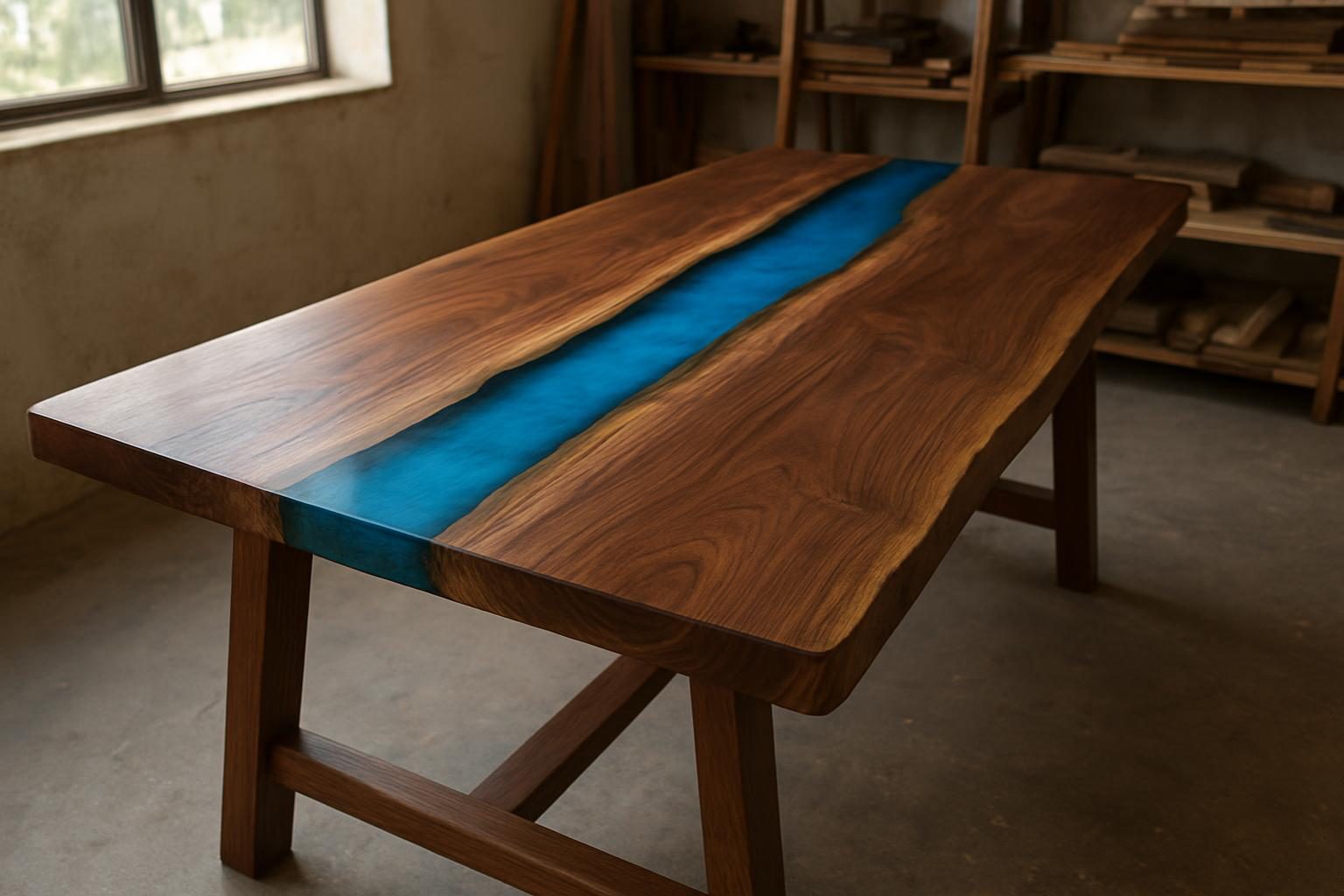
    • Epoxy river tables are a wood-and-resin composite. Solid live edge is one continuous piece (or a few glued boards) of hardwood with a natural edge.
    • Epoxy looks dramatic and is easy to wipe down, but it scratches, scuffs and softens under heat, and it can’t be sanded back as freely as wood.
    • Solid live edge is more repairable and ages gracefully, but it moves with humidity and needs a flat, stable slab.
    • Epoxy costs more because of the resin, mold work and labor. Expect a meaningful premium over a comparable solid slab table.

    What each table actually is

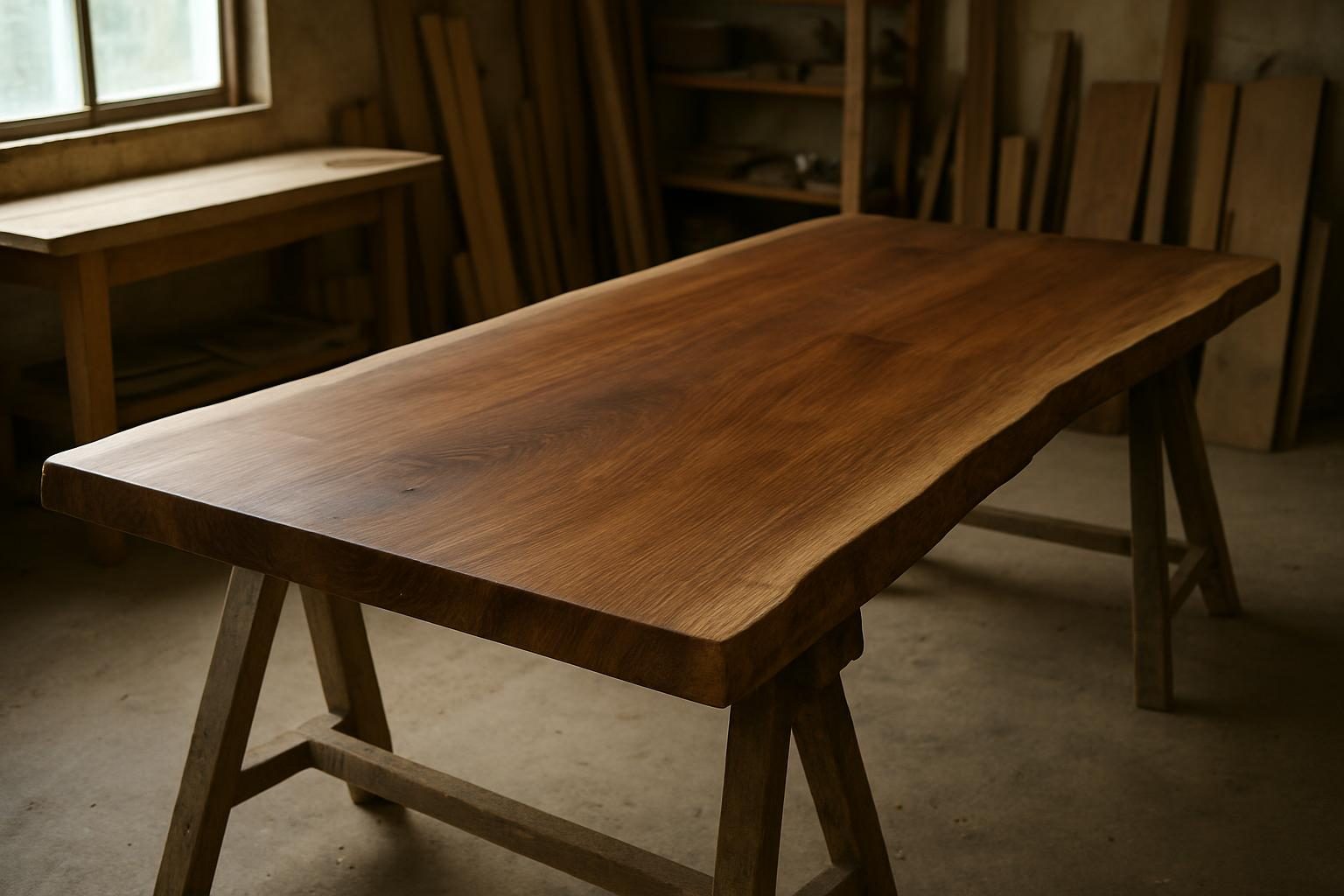
    A solid live edge table is built from a hardwood slab (or two matched slabs) that keeps the natural contour of the tree on one or both long edges. The bark is removed, the edge is cleaned and sealed, and the top is flattened, sanded and finished. What you see is wood from edge to edge.

    A live edge epoxy table, usually called a river table, starts with the same kind of slab but splits it into two halves. The halves are set apart in a mold, and the gap is filled with poured epoxy resin, often tinted blue, green or clear. The “river” is the resin channel running between the live edges.

    Both can be beautiful. They just behave very differently once they are in a dining room or living room, which is what the rest of this post covers.

    Durability: scratches, heat and daily wear

    Cured epoxy is hard but not tough in the way people assume. It sits around Shore D 75 to 85 on the hardness scale, which resists dents but scratches readily and shows fine surface haze from plates, keys and laptop corners. Hardwoods like white oak (Janka around 1,360 lbf) and walnut (around 1,010 lbf) mark differently: they dent before they scratch, and the marks tend to hide in the grain.

    Heat is the bigger difference. Most tabletop epoxies start to soften somewhere between 120 and 140 degrees Fahrenheit, and a hot pan or coffee pot can leave a permanent ring or cloudy spot in the resin. A solid wood top with a good finish handles brief heat better, though no finish is immune, and you should still use trivets either way.

    UV is another factor. Many epoxies yellow or haze over the years with direct sun unless they include UV stabilizers, which are not a guarantee. A table by a west-facing window in Eastern North Carolina will see more of this than one in a shaded room.

    Solid live edge hardwood table top with natural edge and oil finish in a workshop

    Repairs and how each one ages

    This is where solid wood wins most clearly. A scratch, ring or dull patch on a hardwax oil finish can usually be sanded out and re-oiled in an afternoon, and the table looks better afterward. Our post on hardwax oil vs polyurethane covers why the finish you choose changes how repairable a top is.

    Epoxy is harder to fix. Light scratches can be buffed out, and shallow ones can be re-polished, but deep gouges mean sanding through the resin and recoating, and the repair is more likely to show. Chips along the resin-to-wood joint can let moisture creep under the edge over time.

    Neither material lasts forever without attention. The difference is that a solid wood table can be refinished many times over decades, while an epoxy surface has a more limited number of good restorations.

    Wood forgives a sanding block. Resin mostly doesn’t.

    Wood movement: the part nobody mentions

    Wood swells and shrinks across the grain as humidity changes. A wide slab can move a quarter inch or more over a year in a humid climate like coastal North Carolina. Epoxy does not move with it, so a poorly built river table can develop hairline cracks at the resin edge, or the slab can pull away from the pour.

    Solid slabs handle this through good design: proper drying (kiln-dried to roughly 6 to 8 percent moisture), correct thickness, and a base or breadboard-style detail that lets the top move. We go into this in why solid wood furniture cracks, and the same principles apply to the wood halves of an epoxy table.

    If you are considering a river table, ask how the wood was dried and how the epoxy was poured. Deep pours in a single go can overheat and cloud, so quality work is done in layers, and that is part of why the price climbs.

    Cost: where the money goes

    Epoxy tables cost more for good reasons: the resin itself is expensive, a deep pour for a dining-size table needs a lot of it, and the mold, layered pours, flattening and polishing all add labor. A table that would be a straightforward slab build gets a lot more shop time once resin is involved.

    For reference, our solid hardwood dining tables start at $2,200, and a live edge build is priced from the slab, the size and the base. For the general cost picture, see how much a custom dining table costs.

    FactorEpoxy river tableSolid live edge
    Scratch resistanceScratches and hazes easilyMarks hide in grain, sands out
    Heat toleranceSoftens around 120-140 FBetter, still use trivets
    RepairabilityLimited, repairs can showRe-sand and re-oil
    Wood movementCan stress the resin jointDesigned to move
    Everyday wipe-downVery easyEasy with a good finish
    Relative costHigherLower for same size
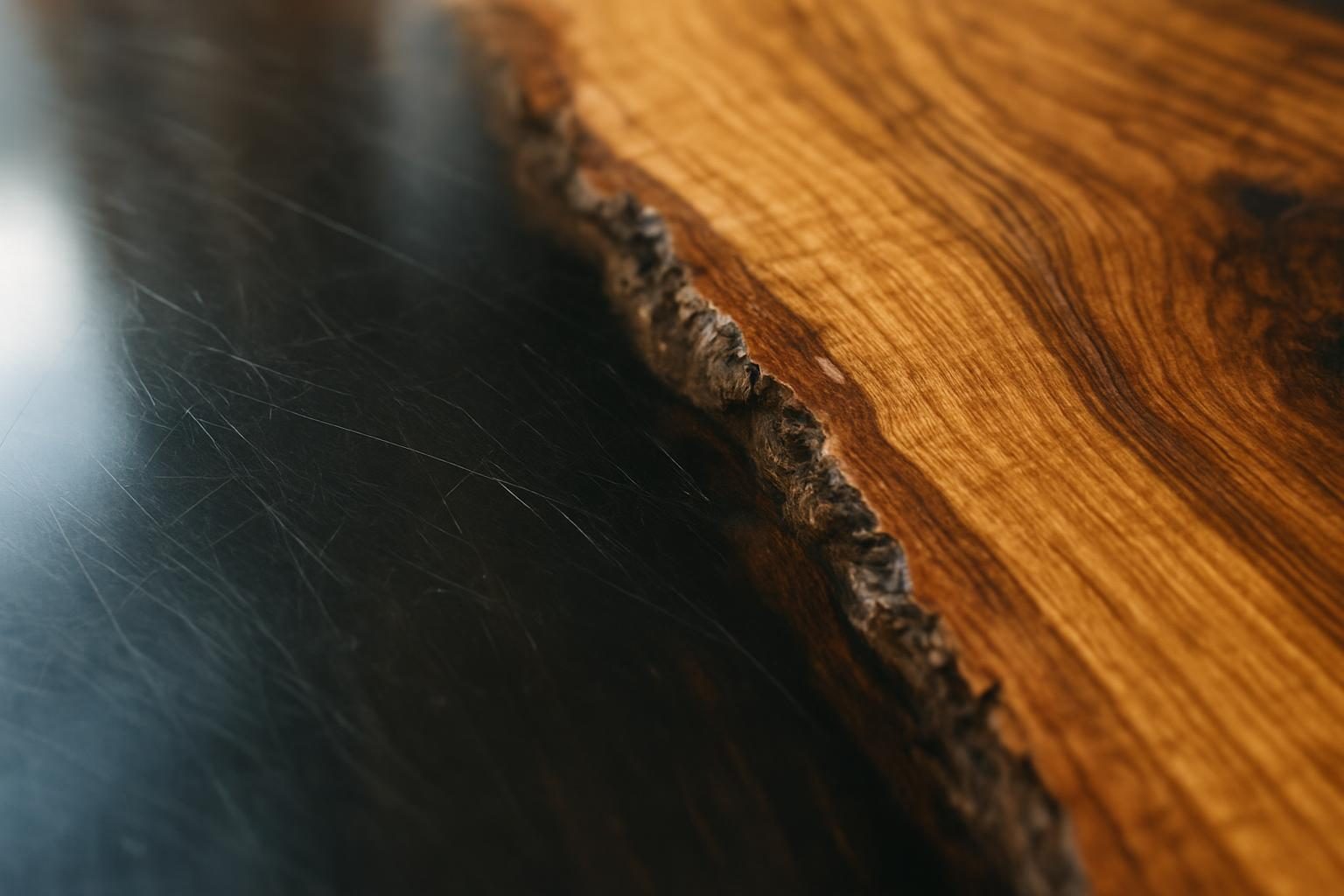
    Close-up of fine scratches and a hot-dish mark on a glossy epoxy tabletop beside a wood grain edge

    Daily care for each

    For an epoxy top, use a soft cloth with mild soap and water, avoid abrasive pads, and keep hot dishes and direct sun off the resin. Felt pads under everything are worth the trouble.

    For solid live edge, wipe spills promptly, keep the top out of the path of heating vents, and re-oil a hardwax finish once or twice a year as it dulls. Our guides on caring for a solid wood table and removing water rings walk through the specifics.

    Shop tip: Whichever top you choose, put a felt-backed trivet and placemats where the family actually eats. Most of the damage we see on both materials comes from hot cookware and sliding ceramic, not from anything dramatic.

    Pick the table you are willing to care for, not just the one that photographs best.

    Which one should you choose

    Choose an epoxy river table if the color and the dramatic look are the point, you will be careful with it, and the budget is there. It makes a striking statement piece, and it suits a room where the table is the focal point.

    Choose solid live edge if you want a top that handles real family use, can be refinished for decades, and lets the character of the wood do the talking. It is also the more economical route to the same natural-edge look, and it leaves budget for a better base. If you are leaning that way, our live edge coffee table guide shows how slab size and height play out in a smaller piece.

    If you are near Jacksonville, NC, or anywhere in Onslow County, including Hubert, Swansboro, Sneads Ferry, Richlands and the Camp Lejeune area, we handle furniture pickup and delivery locally. Our commission process explains how quotes, deposits and builds work.

    FAQ

    Is an epoxy river table durable enough for a dining table?

    It can work, but it is less forgiving than solid wood. Epoxy scratches more visibly and can soften under hot dishes, so a dining table that sees daily use needs trivets and placemats. A solid hardwood top is the lower-maintenance choice for a busy household.

    Does epoxy yellow or crack over time?

    Some epoxies yellow with sun exposure unless they contain UV stabilizers, and cracking usually comes from wood movement or a rushed, deep pour. Proper kiln drying and layered pours reduce the risk, but neither is a guarantee. Ask the maker how the piece was built.

    Can a scratched epoxy table be repaired?

    Light scratches can often be buffed or re-polished. Deep gouges mean sanding and recoating the resin, and the repair may be visible. Solid wood with an oil finish is generally easier to restore.

    If you are weighing a live edge table for your home, request a quote at /commission/ and tell us what you have in mind.

  • Maple vs Walnut Cutting Boards: Hardness, Looks and Staining

    Maple vs Walnut Cutting Boards: Hardness, Looks and Staining

    The short version

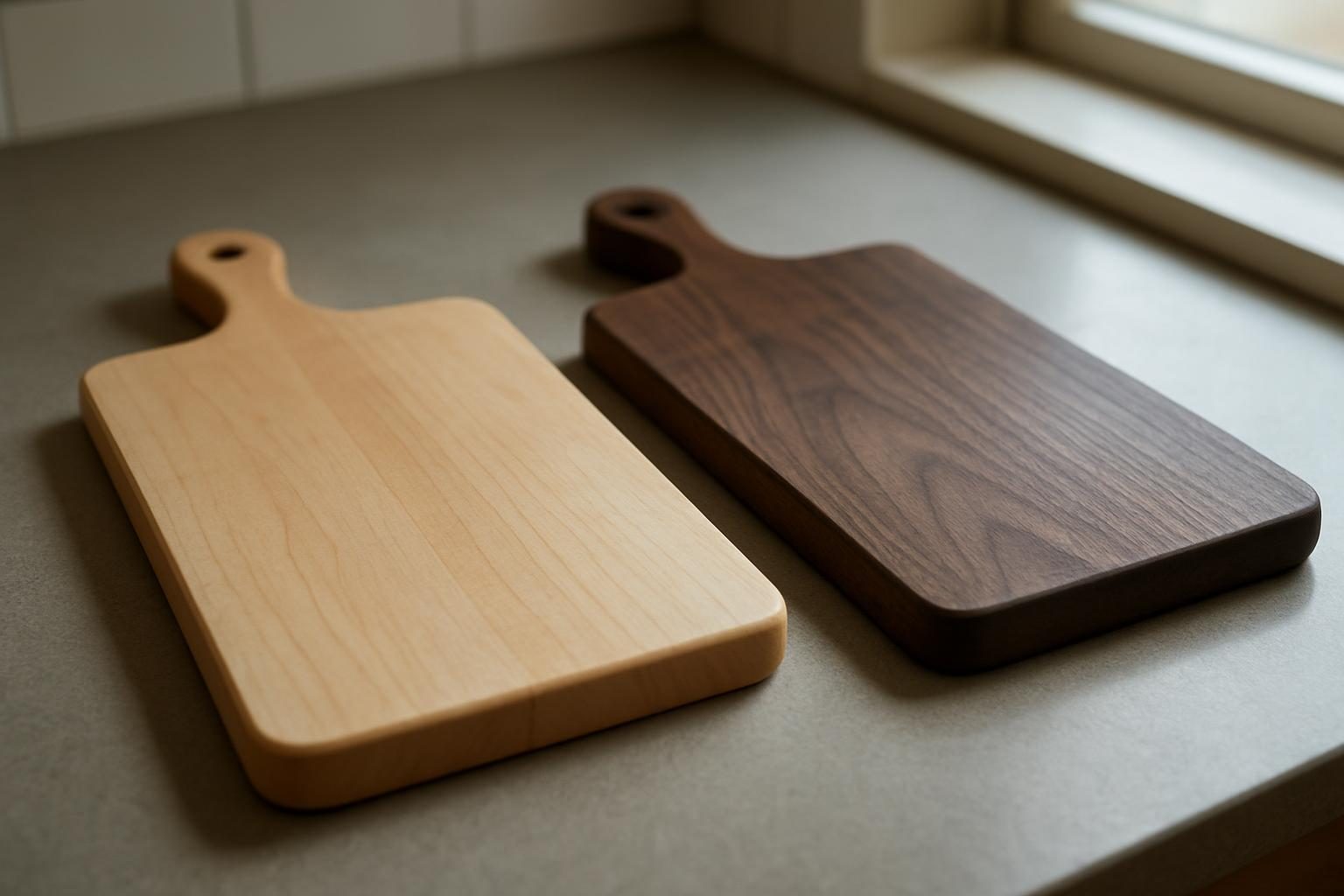
    • Hard maple (1,450 Janka) is harder than black walnut (1,010 Janka), but both are safe for knives and both are closed-grain hardwoods suited to food.
    • Maple is pale and shows stains more. Walnut is dark brown and hides them, but it also hides crumbs and cut marks you may want to see.
    • Walnut boards usually cost more than maple boards of the same size and construction because the lumber costs more.
    • Neither wood is food-safe in a way the other is not. Oiling and cleaning habits matter more than the species.
    • If you cannot decide, a maple and walnut combination board gives you both looks in one piece.

    Maple and walnut are the two woods most people end up choosing between for a cutting board, and it is a fair contest. Both are dense, tight-grained North American hardwoods that have been used for chopping blocks for generations. The real differences are hardness, color, how each one handles stains, and price.

    This is a straight comparison from a shop that builds boards in both. If you want the wider field of woods, including cherry and the ones to avoid, our guide to the best woods for cutting boards covers them.

    Hardness: Maple vs Walnut on the Janka Scale

    The Janka test measures how many pounds of force it takes to push a steel ball halfway into a piece of wood. Hard maple, also sold as sugar maple, rates about 1,450 lbf. Black walnut rates about 1,010 lbf.

    In practice, that makes maple the tougher surface. It resists deep knife scoring and dents from a dropped pan better than walnut does. Walnut sits in a comfortable middle: hard enough to last for years, soft enough that it is gentle on your edge.

    TraitHard MapleBlack Walnut
    Janka hardness~1,450 lbf~1,010 lbf
    GrainClosed, fine, evenClosed to semi-open, a bit more figure
    ColorCream to light tanChocolate to dark brown
    Shows knife marksYes, in light scratchesLess visible
    Shows food stainsMoreLess
    Relative priceLowerHigher

    Hardness gets overplayed in cutting board conversations. A knife is steel, and both woods are far softer than steel. The bigger factor for edge life is whether the board is end grain or edge grain, which we compare in end grain vs edge grain cutting boards.

    How They Look and Age

    Maple is the clean, bright option. It has a fine, even grain that reads as modern and neutral, and it pairs well with white countertops and light cabinetry. Over time it warms to a soft honey tone, especially with regular oiling.

    Walnut is the dramatic one. The color runs from medium brown to near-black, sometimes with purple or gray streaks and occasional lighter sapwood. It looks rich on a dark countertop and holds up visually in a busy kitchen.

    Walnut does lighten slowly with sun exposure, so a board that lives on a sunny counter will shift a little over the years. Maple tends to move the opposite direction, deepening to a warmer tone. Neither change is a defect, just wood being wood.

    Pick maple if you want to see the board work, and walnut if you want the board to look good while it works.

    Staining: Which One Shows Wear Less?

    This is where the two woods feel most different day to day. Maple is pale, so beet juice, turmeric, red wine and coffee leave visible marks. They are surface stains and usually fade or sand out, but they do show.

    Walnut hides most of that. A dark board can sit through a week of tomato sauce and berry prep and still look uniform. The tradeoff is that you also lose the contrast that shows when a board needs a proper wash, so build a cleaning habit instead of waiting for it to look dirty.

    For both woods, the same basics keep a board healthy:

    • Wash with mild soap and warm water right after use, then dry it standing on its edge.
    • Never soak a board or run it through the dishwasher.
    • Oil it with food-grade mineral oil whenever it looks dry or pale.
    • Sand lightly and re-oil if a stain bothers you.

    Our walkthrough on how to oil and clean a wood cutting board has the full routine.

    Close-up of maple and walnut wood grain compared

    Should You Stain a Cutting Board?

    Short answer: no. Wood stains and dyes are not made for surfaces that touch food and take knife cuts, and a cutting board gets sanded and re-oiled over its lifetime, which exposes bare wood again. Skip any finish that is not labeled food-safe.

    If you want a darker board, buy walnut instead of staining maple. It gives you depth of color that runs all the way through the wood, so a scratch never reveals a pale layer underneath. That is the honest reason people choose walnut over maple, and it is a good one.

    The only finish a cutting board needs is a food-safe oil, sometimes paired with a beeswax blend for a bit more water resistance. Both woods take oil well and look noticeably richer after the first few coats.

    Shop tip: If you are torn, ask for a board with both woods in it. Alternating maple and walnut strips in an end grain pattern gives you the contrast of a checkerboard and the practical benefits of each species.

    Price and Build Differences

    Walnut lumber costs noticeably more than hard maple, and that carries through to the finished board. Our cutting boards start at $95, and walnut versions of the same size and construction generally land above the maple ones. Board size, thickness, and whether it is edge grain or end grain move the price more than the species does.

    Thickness is worth caring about. A board around 1.5 inches thick stays flat, resists warping, and has some heft on the counter. Thinner boards are lighter but more likely to cup if they get wet on one side.

    Here is a quick guide to which wood tends to suit which situation:

    • Busy family kitchen, lots of daily chopping: Maple. It is the tougher surface and the lower price makes it easy to replace in ten years.
    • Serving boards and charcuterie: Walnut. The dark color shows off cheese, fruit and cured meat.
    • Gift: Walnut or a combination board. It photographs well and feels like an upgrade.
    • Dark countertops and cabinets: Maple for contrast, or walnut for a tonal look.

    The best cutting board is the one you will actually wash, dry and oil.

    Which One We Would Pick

    For a primary chopping board that sees daily use, hard maple is the practical choice. It is harder, cleaner looking, and easier on the budget. For a board that sits out on the counter and doubles as a serving piece, walnut earns its higher price.

    Both are safe for food and both will last for years when cared for properly. If you are weighing walnut against another popular furniture wood, our comparison of walnut vs white oak is a useful companion, and the shop’s wood guide lays out the species side by side. You can see current options on our cutting boards page.

    Oiling a walnut cutting board with food-safe mineral oil

    Boards ship anywhere in the US. If you are in Jacksonville or elsewhere in Onslow County, we also handle local pickup, which is easy to arrange if you are ordering furniture alongside a board.

    FAQ

    Is maple or walnut better for a cutting board?

    Neither is better across the board. Maple is harder and cheaper, which suits heavy daily chopping. Walnut is darker, hides stains better, and looks richer as a serving board. Both are tight-grained hardwoods that are widely used for food surfaces.

    Is walnut safe for cutting boards?

    Yes. Black walnut is a standard cutting board wood and is considered safe for food contact. People with tree nut allergies should be cautious with any walnut board, so mention it if you are gifting one or cooking for someone with a nut allergy.

    Will a maple cutting board stain?

    It can. Pale maple shows pigments from beets, turmeric, berries and wine. These are usually surface marks that fade with washing or come out with a light sanding and fresh oil, so they are cosmetic rather than a sign of damage.

    If you are ready to choose a wood, size and style, request a quote at /commission/.

  • Rounded Edge Coffee Tables: Edge Profiles and Family-Friendly Design

    Rounded Edge Coffee Tables: Edge Profiles and Family-Friendly Design

    A coffee table sits at exactly the height of a toddler’s forehead and an adult’s shin. That’s why the edge matters more here than on almost any other piece of furniture. A square, sharp-cornered edge is fine until the first stumble; a well-rounded one is something you stop thinking about.

    The short version

    • Rounding an edge is about two things: what happens when someone bumps it, and how well the finish survives daily wear.
    • A 1/4 inch roundover is the minimum for comfort; 1/2 inch or more is a better fit for a home with small children.
    • Rounded corners (a radius in the tabletop’s plan view) matter as much as rounded edges.
    • Harder woods like white oak and maple hold a soft edge longer than softer ones like pine or cherry.
    • Our coffee tables start at $850, and edge profile is something you choose when you commission.

    Edge vs. Corner: Two Different Kinds of Rounding

    People say “rounded edge” and mean two things. The edge is the long arris running along the top and bottom of the tabletop, which you can round with a router bit or hand plane. The corner is the shape of the tabletop itself when viewed from above, where a 90-degree point can be left sharp or cut to a curve.

    For a family room you usually want both. A table with a generous roundover but square corners still has four points sticking out at knee and head height. A table with rounded corners but a razor-crisp edge still feels sharp under a forearm or a hip.

    If you’re choosing between them, put the budget into the corners first. A corner radius of 2 to 4 inches takes the point out of the table entirely, and it costs only a little more labor than a square corner.

    The Common Edge Profiles, Compared

    Not every soft edge is the same shape, and each one changes how the table looks and feels. Here are the profiles we get asked about most, and what they’re good for.

    ProfileWhat it looks likeBest for
    Small roundover (1/8 to 1/4 in)Crisp, modern, barely softenedAdult households, clean contemporary lines
    Medium roundover (3/8 to 1/2 in)Clearly soft, still definedMost family rooms; good all-around choice
    Full bullnose (about 3/4 in, half the thickness)Fully rounded, almost pillowyToddlers, rental-friendly feel, farmhouse styles
    Eased edge (just broken, about 1/16 in)Looks square, feels safe to touchMinimalist tables where you don’t want a visible profile
    Chamfer (angled cut)Flat bevel, angularMid-century and Shaker-leaning styles

    The eased edge deserves a mention because it’s often overlooked. It reads as a square-edged table in a photo but won’t chip or catch a fingernail, which makes it a good middle path if you like the crisp look.

    Router with a roundover bit shaping the edge of a hardwood tabletop in a small woodshop

    A soft edge is a kindness you only notice when you bump it.

    Which Radius Should You Pick?

    For the tabletop edge, think in terms of the thickness of the top. Most solid coffee tables run 1-1/2 to 2 inches thick. A roundover of 1/2 inch on a 1-1/2 inch top looks balanced; push it to a full 3/4 inch bullnose and the whole top reads as rounded.

    For corners, the radius is measured as if you were drawing a circle at the corner. A 1 inch radius still feels pointy to a child; 3 inches is where the corner stops reading as a corner. On a standard 48 by 24 inch rectangular top, a 3 inch radius is a gentle softening, and 6 inches starts to look like a rounded rectangle.

    If your sofa sits close and the table lives in a tight walkway, go bigger on both. The sizing guide in Coffee Table Size Guide: Length, Height and Distance from the Sofa covers how far the table should sit from the seating, which affects how often you’ll catch an edge.

    Wood Choice and How Long the Edge Lasts

    A rounded edge only stays rounded if the wood underneath can take a knock. Softer woods dent and compress at the very edge, and that’s where kids drag toys and adults set down mugs. Hardness is measured by Janka rating, and the spread across common furniture woods is wide.

    • Hard maple: about 1,450 lbf. Very dense, takes a smooth, tight edge, and resists denting well.
    • White oak: about 1,360 lbf. Hard and open-grained, a strong all-rounder for family tables.
    • Black walnut: about 1,010 lbf. A good balance of workability and durability; dents a little more than oak but hides it well in the grain.
    • Cherry: about 950 lbf. Softer, and it will pick up small dings over the years, though many people like that worn look.

    For a table that will see real use, we lean toward white oak or maple. If you want to see the species side by side, the wood guide lays them out, and Walnut vs White Oak: Which Is Better for a Dining Table? explains the trade-offs that carry over to a coffee table.

    Solid hardwood coffee table with rounded corners in a living room beside a sofa

    Finish Matters at the Edge Too

    Edges are where a finish wears through first, because they take the most contact and the thinnest coat. A hard film finish like polyurethane stays smooth but can chip along a sharp edge; a rounded edge holds the film better because there’s no thin ridge for it to break off.

    A hardwax oil is easier to touch up and feels more natural under the hand, which suits a rounded edge that gets handled constantly. We compare the two in Hardwax Oil vs Polyurethane: Choosing a Table Finish, and the right pick depends on how much maintenance you’re willing to do.

    Shop tip: Run your fingertip along the underside edge of any table you’re considering, not just the top. Makers often round the top beautifully and leave the bottom arris sharp, and that’s the edge little hands grab when they pull themselves up.

    Shape, Size and Where the Table Goes

    Edge profile and overall shape work together. A round or oval top has no corners at all, which is the safest option for a room with crawling or newly walking children. A rectangle with generously rounded corners gives you more surface area while still softening the hit zones.

    Standard coffee table heights run 16 to 18 inches, ideally a little below the seat height of your sofa. Length is usually about two-thirds the length of the sofa, so a 84 inch sofa pairs well with a table around 48 to 56 inches. Leave 14 to 18 inches between the table and the sofa so people can pass and get in and out of the seat.

    If you’re in Jacksonville or elsewhere in Onslow County, we can deliver or you can pick up locally, which makes it easy to see the edge in person before it goes into your room. You can browse the options on our coffee tables page and see how a commission moves from sketch to finished piece on the process page.

    Good design for a family room starts with where the corners land.

    What to Ask When You Commission

    When you’re specifying a table, be concrete about the edge. “Rounded” is not enough information, and different makers will interpret it differently. Give a number and a shape so the quote matches what you’re picturing.

    • Tabletop edge profile and radius (for example, 1/2 inch roundover top and bottom).
    • Plan-view corner radius (for example, 3 inch corners).
    • Whether the leg and apron edges are eased or rounded too.
    • Species and finish, since both affect how the edge wears.

    We quote a fixed price after we’ve agreed on these details, with a 50% deposit to start the build. Our coffee tables begin at $850, and the edge work is part of the design conversation rather than a surprise add-on.

    FAQ

    What is the safest edge for a coffee table with toddlers?

    A full bullnose or a roundover of 1/2 inch or more, combined with plan-view corners rounded to a 3 inch radius or larger. A round or oval top removes corners entirely and is the safest shape.

    Do rounded edges cost more?

    Slightly, because they take more shaping and sanding time than a plain square edge. The difference is small compared with the overall cost of a solid wood table, and it’s worth it for a table that sits at head height for small children.

    Can I round the edges of my existing coffee table?

    Often yes, if the top is solid wood and thick enough, using a router with a roundover bit followed by sanding and refinishing the edge. Veneered tops are risky because you can cut through the thin face layer, which is covered in Solid Wood vs Veneer Furniture: What You’re Really Paying For.

    If you’d like a coffee table with the edge profile and corner radius worked out for your room, you can request a quote at /commission/.

  • Mid-Century Modern Coffee Tables in Solid Wood

    Mid-Century Modern Coffee Tables in Solid Wood

    The short version

    • The look comes from low, light proportions: roughly 15 to 17 inches tall, with legs that taper and splay slightly.
    • Walnut is the classic choice, but white oak, cherry and maple all work if you match the finish to the room.
    • Legs should taper on the inside faces, from about 1-3/4 inches at the top to 3/4 inch at the floor.
    • A solid wood version starts around $850 and rises with size, species and joinery.

    Mid-century modern furniture looks easy to copy, and that’s the trap. The shapes are so clean that any mistake in proportion shows immediately. A leg that’s a quarter inch too thick or a top that’s two inches too deep can turn an elegant piece into a clunky one.

    This guide covers what actually defines the style in a coffee table, which woods suit it, and the dimensions we use when we build one. If you want to look at what we make before reading on, our coffee tables page shows the range.

    What Defines a Mid-Century Modern Coffee Table

    The style grew out of the 1940s through the 1960s, when designers wanted furniture that was honest about its materials and light on its feet. In a coffee table, that comes down to a handful of traits. You can check any table against them.

    • Low and horizontal. Most sit 15 to 17 inches tall, lower than a typical contemporary table.
    • Tapered legs. The legs get thinner toward the floor, often angled outward a few degrees.
    • Visible wood grain. Walnut, teak and oak were standard, usually with a clear oil or light finish.
    • Clean edges. Square or softly eased edges, rather than heavy profiles or applied trim.
    • Space under the top. Thin aprons or none at all, so you can see through the table.

    Notice what’s missing: ornament. The design is the proportion, the wood and the joinery. That’s why a mid-century modern coffee table in solid wood feels different from a veneered copy, since the grain and edges carry the whole look.

    When a design has no decoration, every dimension has to be right.

    Tapered Legs: Where the Style Lives

    If you only get one thing right, make it the legs. A tapered leg lightens the whole table, because your eye reads the thin foot and assumes the piece is delicate. A straight leg of the same thickness reads as heavy.

    A good starting point is a leg about 1-3/4 inches square at the top, tapering to roughly 3/4 inch at the floor. We usually taper the two inside faces and leave the outside faces straight, which keeps the leg flush with the edge of the top and gives a clean line from above. Tapering all four faces is a valid choice too, though it changes the feel to something a little more delicate.

    Splay is the second decision. A slight outward angle, around 5 to 8 degrees, gives the table that planted, confident stance. Splayed legs are harder to build, because the joints to the apron or top are cut at compound angles. That extra work is a real part of the price, and it’s also what separates a well-made table from a flat-pack one.

    Close-up of a tapered walnut coffee table leg joined to the underside of the top

    Why Walnut Fits the Style

    American black walnut is the wood most people picture. It has a Janka hardness of about 1,010 lbf, which is firm enough for daily use and soft enough to work cleanly into fine tapers. Its color runs from chocolate brown to purple-gray, and a clear oil finish deepens it without hiding the grain.

    Walnut isn’t the only good option, though. White oak (around 1,360 Janka) gives a lighter, calmer look and pairs well with the Scandinavian side of the style. Cherry (about 950) starts pale and darkens, which we cover in why cherry wood darkens. Hard maple (about 1,450) is the lightest and hardest of the group.

    SpeciesJanka (lbf)LookBest for
    Black walnut~1,010Deep brown, warmThe classic mid-century look
    White oak~1,360Light tan, subtle grainLighter, Scandinavian-leaning rooms
    Cherry~950Reddish, darkens over timeWarm rooms that welcome patina
    Hard maple~1,450Pale, uniformBright, minimal spaces

    For a deeper species comparison, see our wood guide. If you’re choosing between the two most popular options, the post on walnut vs white oak applies to coffee tables as well, since the wood behaves the same way at any size.

    Pick the wood for the room it will sit in, not just the style it comes from.

    Proportions: The Numbers We Work From

    Here’s where the style becomes practical. These are typical dimensions for a rectangular mid-century modern coffee table, and they’re a starting point rather than a rule. The right size depends on your sofa and your floor space, which our coffee table size guide walks through in detail.

    • Length: 44 to 54 inches, about two-thirds the length of the sofa.
    • Width: 22 to 28 inches. Narrower than a modern chunky table, which keeps it light.
    • Height: 15 to 17 inches, ideally within an inch of the sofa seat height.
    • Top thickness: 3/4 to 1-1/4 inches. A thin top with eased edges looks refined, while a thick slab looks rustic.
    • Distance to sofa: 14 to 18 inches, so you can reach your drink and still walk past.

    Top thickness is the dimension people overlook. Mid-century tables usually have slim tops, sometimes with a slight bevel on the underside so the edge looks thinner than it is. A 1-1/2 inch slab on tapered legs fights the style, because the heavy top visually overwhelms the delicate legs.

    Walnut boards and hand tools on a workbench in a small woodshop

    Solid Wood vs Veneer for This Style

    Plenty of mid-century modern coffee tables, including many vintage originals, use veneer over a core. There’s nothing wrong with good veneer work, but the clean, edge-forward design shows its weakness more than most. Visible edges are where veneer tables give themselves away.

    A solid top can be sanded and refinished for decades, so a ring or scratch isn’t permanent. We break down the tradeoffs honestly in solid wood vs veneer furniture. For a table that will sit in a living room for twenty years, solid is usually the better value even at a higher starting price.

    Shop tip: Check the top from a seated position before you commit to a height. If the table sits much above the sofa seat, it will feel like a barrier. Right around the seat height, it feels like part of the room.

    Finish and Care

    A mid-century look usually calls for a finish that stays close to the wood. Hardwax oil gives a soft, natural sheen and is easy to spot-repair, while polyurethane gives a harder surface film that resists spills. We compare them in hardwax oil vs polyurethane.

    For a coffee table that gets coasters, remotes and the occasional mug, either works if you keep up with it. Wipe spills promptly, use coasters for hot cups, and re-oil an oiled surface once or twice a year. The care routine is the same one we outline for tables of any size.

    What a Solid Wood Version Costs

    Our coffee tables start at $850, and a mid-century style piece in walnut typically lands above that starting point. Price moves with length, species, how much splay and taper the legs have, and any extras like a lower shelf or a drawer. Walnut costs more than oak or maple per board foot, so species is often the biggest single factor.

    Every commission gets a fixed quote and a 50% deposit, so there are no surprises as the build goes on. If you’re curious how the steps run from first message to finished piece, how a commission works lays it out. We build for homes across Jacksonville, NC and Onslow County, including Hubert, Swansboro, Sneads Ferry and Richlands, with local pickup or delivery.

    FAQ

    How tall should a mid-century modern coffee table be?

    Most fall between 15 and 17 inches. The best rule is to match your sofa seat height within about an inch, so the table feels level with where you sit.

    Is walnut the only wood for a mid-century look?

    No. Walnut is the classic choice, but white oak, cherry and hard maple all suit the style. The shape, tapered legs and slim top matter more than the species.

    Why are tapered legs more expensive to build?

    Each leg needs extra machining to cut the taper cleanly, and splayed legs add compound-angle joinery. That’s more setup and more careful fitting than a straight square leg, which is why well-made versions cost more than flat-pack ones.

    If you’d like a mid-century modern coffee table built to your room’s dimensions, you can request a quote at /commission/.

  • French Country Dining Tables: Style Details, Woods and Sizes

    French Country Dining Tables: Style Details, Woods and Sizes

    The short version

    • French country tables are defined by shaped legs (turned, cabriole or tapered), a rounded or beveled edge and a soft, lived-in finish, not by a single fixed design.
    • Oak, cherry and walnut all suit the style; oak is the most traditional, cherry is the warmest, and walnut reads darker and more formal.
    • Plan on 36 to 42 inches wide and 72 to 96 inches long for most rooms. An oval or a table with a drop leaf softens tight spaces.
    • Custom dining tables in our shop start at $2,200. Heavier carved or turned work sits toward the upper end of the range.

    What actually makes a table French country

    French country is a style, not a blueprint. Think of the tables you would find in a farmhouse in Provence or Normandy: sturdy, a little worn, built to be used every day, but with more curve and grace than a plain American farmhouse table. The look comes from a handful of details working together.

    If you are weighing it against a plainer look, our post on farmhouse dining tables covers the squarer, more utilitarian cousin. French country borrows the same honest construction but adds shape.

    • Legs with some character: turned (lathe-shaped) legs, gently curved cabriole legs, or a tapered square leg with a fluted or reeded face.
    • A softened edge: a rounded-over or beveled top edge rather than a sharp 90-degree corner.
    • An apron with detail: the rail under the top is often shaped, scalloped or has a simple molding.
    • A warm, matte finish: satin or low sheen that lets the grain show, sometimes lightly distressed or limewashed.
    • Generous proportions: a table that feels solid and a bit stately without being fussy.

    Leg and base styles that fit the look

    The base does most of the style work. A plain post leg reads modern; the same table on turned or curved legs reads French country at once. Pick the base first, because it drives the cost and the seating plan.

    Turned legs are made on a lathe and run from simple tapered forms to bold bulbs and rings. They are the most traditional choice and they hold up well because the grain runs straight down the length of the leg. A cabriole leg curves out at the knee and back in at the foot; it is more elegant, but the curve means more waste and more shaping time, so expect it to cost more.

    A trestle base is another good fit if you want something sturdy and open. It also leaves more room at the ends for chairs. We compare the two layouts in trestle base vs four legs, which is worth reading before you commit to one.

    The base sets the style; the top just has to be flat, thick and honest.

    Close-up of a turned hardwood table leg and shaped apron on a dining table

    Woods that suit French country

    You have three realistic choices, and each gives a different feel. None is wrong; it depends on how formal you want the room to read and how much color change you can live with. Our wood guide lays the species side by side.

    SpeciesJanka hardnessLook in this styleNotes
    White oak1,360 lbfLight to mid-brown, visible grainThe most traditional pick; very durable and takes a limewash or soft stain well.
    Cherry950 lbfWarm reddish-brown, darkens with ageFine, even grain suits curved work; see why cherry darkens.
    Walnut1,010 lbfDeep chocolate brown, more formalReads richer and darker; pairs well with pale linen and stone.

    If you cannot decide between the two most popular, walnut vs white oak walks through the trade-offs. As a rule of thumb, oak leans country, walnut leans formal, and cherry sits in between and ages beautifully.

    Sizes: how big should the table be

    Start with how many people you seat on a normal night, then add for holidays. A comfortable place setting takes about 24 inches of table edge per person. A table 36 to 42 inches wide gives you room for plates and a few serving dishes without anyone reaching across a canyon.

    • Seats 4 to 6: about 60 to 72 inches long.
    • Seats 6 to 8: about 72 to 96 inches long.
    • Seats 8 to 10: about 96 to 108 inches long, which needs a room at least 14 feet in the long direction.

    Leave 36 inches of clearance between the table edge and the wall so chairs can pull out, and closer to 42 to 48 inches if people walk behind them. Our guides on what size table seats 8 and measuring your dining room go through the numbers with a tape measure in hand.

    Wood samples of white oak, cherry and walnut laid side by side on a workbench

    Shape: rectangle, oval or round

    French country leans toward softer shapes. An oval top removes the sharp corners that catch hips and knees, and it makes a room feel less boxed in. A round table works well for smaller rooms and conversation-heavy households, though it tops out around 60 inches before reaching across gets awkward.

    A rectangular table is still the practical choice for most long, narrow dining rooms and it seats the most people per square foot. We cover the pros and cons in round vs rectangular dining tables. If you want the French feel on a rectangle, a generous rounded-over edge and shaped legs get you most of the way there.

    Soft corners and a thick edge do more for the style than any amount of carving.

    Finish and the lived-in look

    The finish should look like it has been used and loved, not like a showroom floor. A hardwax oil gives a low-sheen, natural look that is easy to touch up, while a catalyzed or polyurethane finish is harder wearing for a busy family table. We break down that choice in hardwax oil vs polyurethane.

    Limewash, a light wire-brushing or a soft distress can add the aged look, but they are decisions to make before the build, not after. Heavy distressing on a new top is something to approach carefully: a few honest nicks look right, while a top beaten to look 200 years old can look forced.

    Shop tip: Ask for a finish sample on the exact species you are choosing. Cherry and oak take the same stain very differently, and a swatch on the real board saves you from a color surprise.

    What it costs and how it gets built

    Custom dining tables from our shop start at $2,200, with the final number set by size, species, base and how much shaping is involved. A plain oak top on straight tapered legs sits near the low end, while a large cherry or walnut table with turned or cabriole legs and a shaped apron climbs from there. How much a custom dining table costs breaks the factors down in detail.

    We work from a fixed quote and a 50% deposit, and you can read the full sequence on how a commission works. We build a few pieces a month, so there is a lead time, and local pickup or delivery is available around Jacksonville, Hubert, Swansboro, Sneads Ferry, Richlands and the Camp Lejeune area.

    FAQ

    Is French country the same as farmhouse?

    No. Farmhouse tends toward straight lines, thick square legs and a plain, utilitarian look. French country adds curves, shaped legs and a more refined edge, though both favor honest solid wood and a worn, comfortable finish.

    What is the best wood for a French country dining table?

    White oak is the most traditional and the most durable, cherry gives a warm tone that deepens with age, and walnut gives a darker, more formal look. All three are hardwoods that hold up to daily meals.

    How wide should a French country dining table be?

    Most are 36 to 42 inches wide, which fits plates and serving dishes comfortably. Go wider than 42 inches only if you have the room and do not mind reaching across for the salt.

    If you have a room and a look in mind, request a quote at /commission/ and we will talk through species, base and size.

  • Personalized Cutting Boards as Wedding and Housewarming Gifts

    Personalized Cutting Boards as Wedding and Housewarming Gifts

    The short version

    • Keep engraving short: a surname, a date and maybe one small line. Less reads better and cuts cleaner.
    • Walnut, hard maple and cherry all engrave well and hold up to daily use. Pick by the recipient’s kitchen, not just color.
    • A board 12 x 18 inches or larger is a real working board; smaller ones are fine for serving but frustrating for chopping.
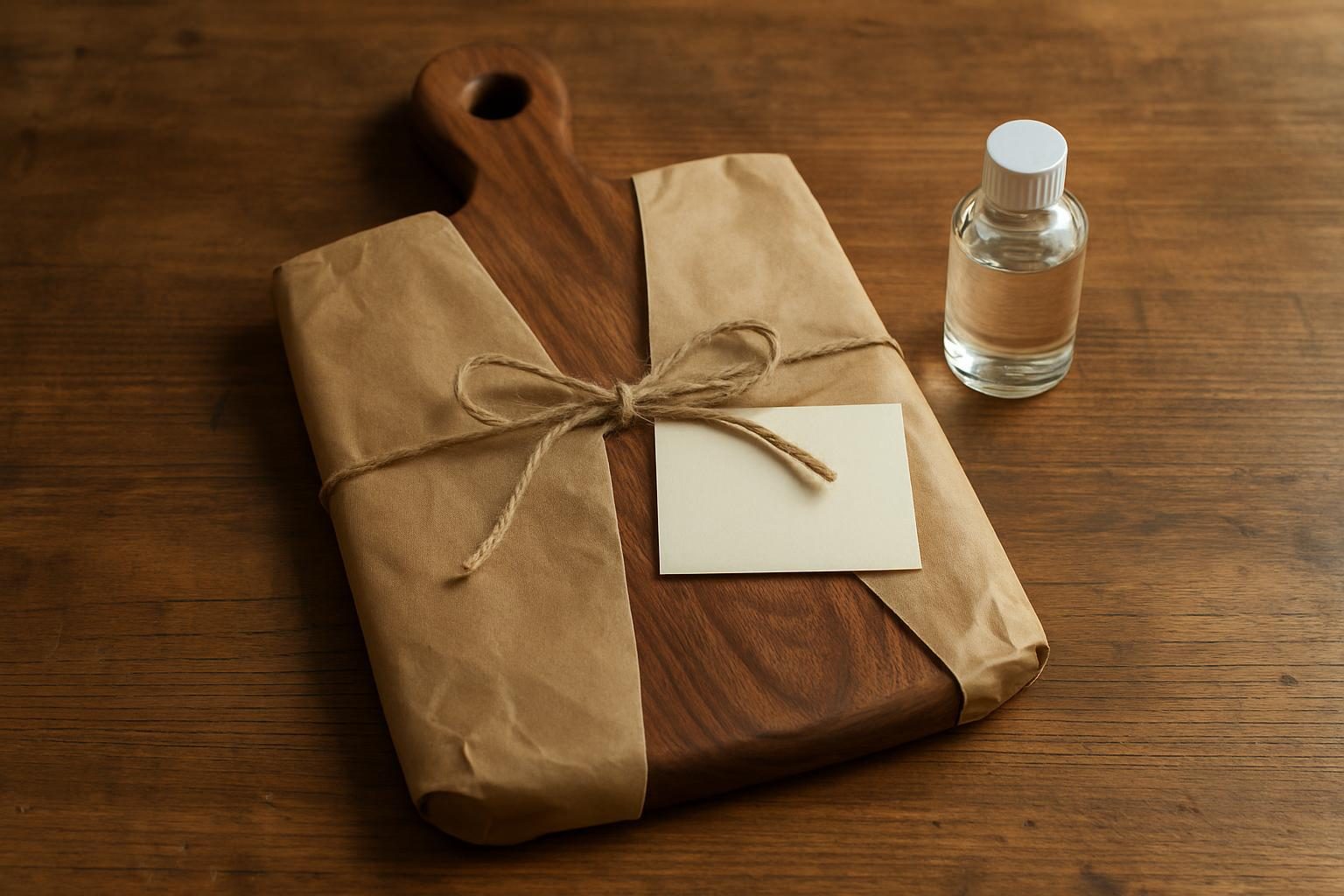
    • Tuck in a one-page care card so the board is still beautiful in ten years.
    • Order early: engraved gifts take shop time, and wedding dates don’t move.

    A cutting board is a good gift for the simple reason that it gets used. A vase gets set on a shelf, but a board comes out for dinner, for the holiday ham and for the cheese plate when company stops by. Put a name and a date on it and it turns into the thing a couple reaches for and remembers who gave it.

    This guide covers the three decisions that matter when you give a personalized cutting board: what to engrave, what wood to choose and how to make sure the recipient takes care of it. We make boards in the shop starting at $95, and the advice below comes from what holds up in real kitchens.

    What to Engrave on a Personalized Cutting Board

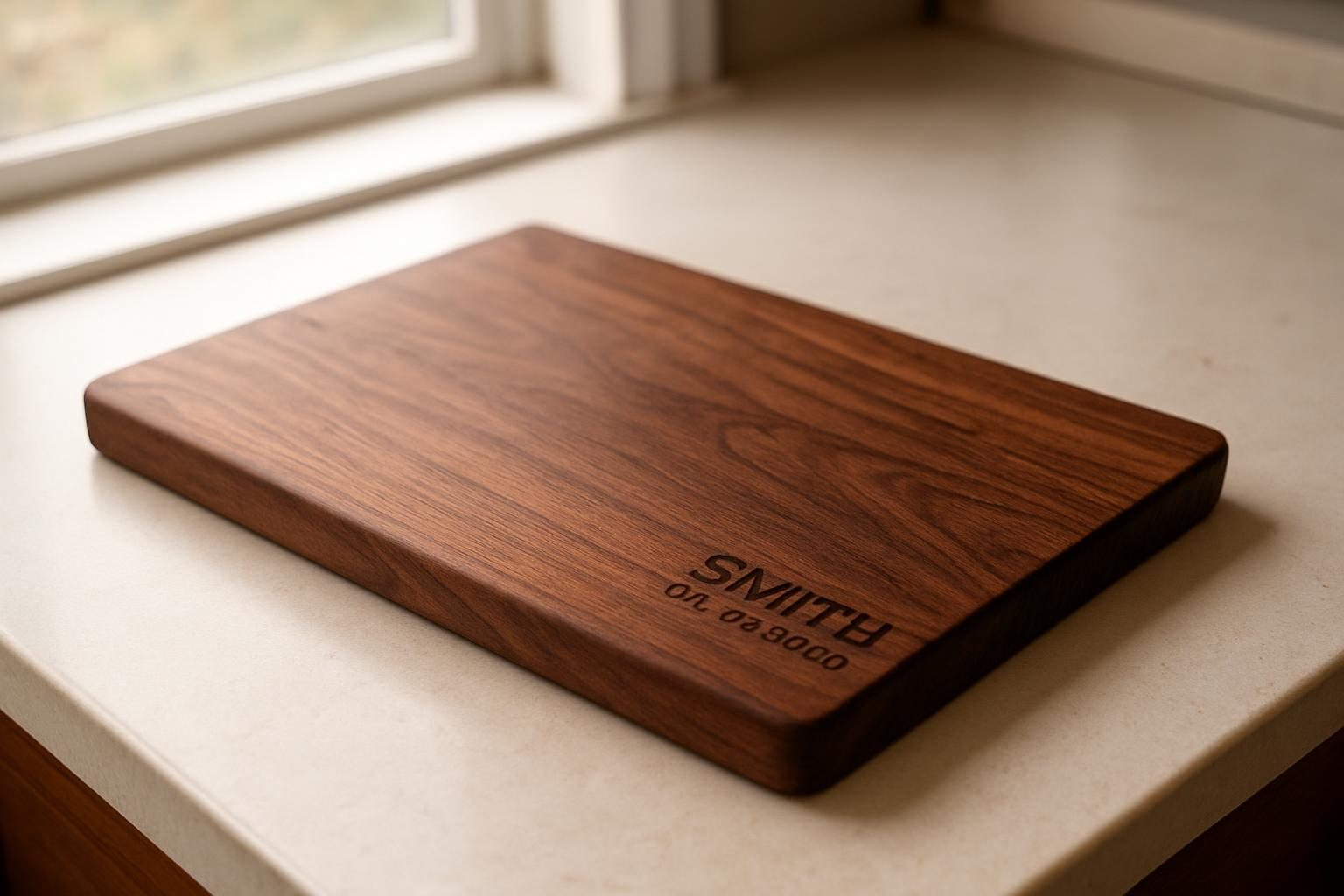
    The best engraving is short enough to read in a glance. A family surname with an established date is the classic for weddings, and it works because it looks like it belongs on a board rather than on a trophy. For a housewarming, a street name, a house number or a simple “Home Sweet Home” tends to land well.

    Here are the layouts that tend to work best:

    • Surname and year: “The Hendersons, Est. 2025.” Reads cleanly and ages well.
    • Initials and date: A monogram with the wedding date underneath. Good for couples who keep different last names.
    • Address or coordinates: Works for housewarmings and says “this is your place” without being sentimental.
    • A short line: A favorite saying, kept to a handful of words. Long quotes get cramped and hard to read.
    • A handwritten signature or recipe: Can be engraved from a clear scan. Check the stroke width first; hairline handwriting can blur in the wood.

    Keep the engraving to one face of the board, ideally the side you’d use for serving. Flip it over and the other side stays clean for chopping, so nobody has to choose between sentiment and function.

    The best engraving is the one you can read from across the kitchen.

    Choosing the Wood for the Gift

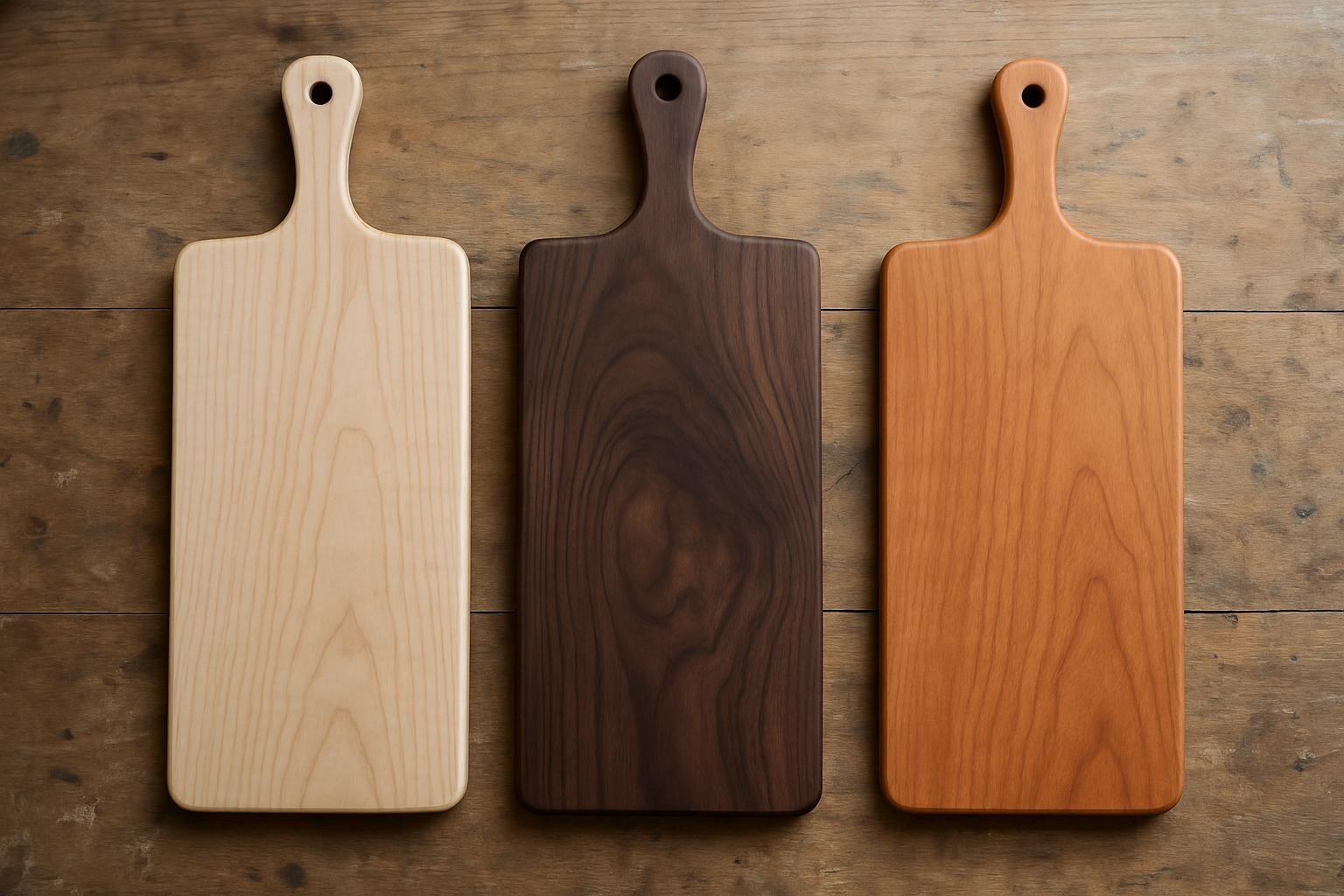
    Wood choice changes how the engraving looks and how the board lives. Walnut is dark, so engraving shows as a soft, low-contrast mark that looks refined. Hard maple is pale, so engraving reads sharp and high-contrast, which is better if the recipient wants the words to stand out.

    WoodJanka hardnessEngraving lookBest for
    Hard mapleabout 1,450High contrast, crispHeavy daily chopping, bright kitchens
    Black walnutabout 1,010Subtle, tone on toneServing boards, dark or warm kitchens
    Cherryabout 950Warm, medium contrastGifts that will deepen in color with age
    White oakabout 1,360Medium, visible grainRustic or farmhouse kitchens

    For a deeper comparison of what’s safe and what to skip, our guide to the best woods for cutting boards covers the food-safety side. Our wood guide shows the species side by side if you want to compare grain and color before you decide.

    Side-by-side hard maple, walnut and cherry cutting boards showing different wood tones

    Size and Construction: Edge Grain or End Grain

    Size is where gift boards most often go wrong. A board under about 10 x 14 inches is a serving piece; it looks nice on a table but a whole chicken or a pile of onions will crowd it. For a board someone will really cook on, 12 x 18 inches is a sensible minimum, and 15 x 20 gives a serious cook room to work.

    Thickness matters too. Around 1.5 inches is a good working thickness: heavy enough to stay put on the counter, thick enough to be flattened or refinished later. Go thinner and it can cup; go much thicker and it gets awkward to lift and store.

    Construction comes down to edge grain versus end grain. Edge grain is the more affordable option and is plenty durable. End grain is gentler on knife edges and shows a checkerboard pattern, but it costs more and needs a little more oil. We break the trade-offs down in end grain vs edge grain cutting boards, which is worth a read if you’re deciding for a keen cook.

    Shop tip: If you don’t know how the recipient cooks, go edge grain in walnut or maple at 12 x 18 inches or larger. It suits nearly everyone, it’s forgiving about care and it leaves room for a clean engraving.

    A board that’s too small to use ends up as decoration, and that defeats the point of the gift.

    The Care Card: Tuck One In

    Most boards that look tired after a year weren’t badly made; they were never oiled or they spent a night in the dishwasher. A short care card fixes that, and it’s the most useful thing you can add to the gift. Keep it to a single page that stays in the kitchen drawer.

    Here’s what the card should say:

    • Wash by hand with mild soap and warm water, then dry it right away with a towel.
    • Never soak it and never put it in the dishwasher. Heat and standing water warp and split wood.
    • Oil it with food-grade mineral oil when the surface looks dry or pale, about once a month at first.
    • Stand it on edge to dry so air reaches both faces evenly.
    • Sand out knife marks with fine paper and re-oil if the surface gets rough.

    For the full routine, point them to how to oil and clean a wood cutting board. You can also include a small bottle of mineral oil with the gift, which turns good advice into something they can do that same weekend.

    Cutting board wrapped in kraft paper with a care card and a small bottle of mineral oil

    Timing, Budget and Ordering

    Plan on a few weeks of lead time for an engraved board, longer around wedding season and the holidays. Our boards start at $95 and the price climbs with size, wood and construction; a large end grain walnut board costs noticeably more than a small maple serving board. If the gift is for a wedding, order at least a month ahead so there’s room for a proof of the engraving.

    Boards ship anywhere in the US, so the recipient doesn’t need to be nearby. If you’re local, we also serve Jacksonville and the rest of Onslow County for furniture pickup and delivery, so a board and a larger piece can often be handled together. You can browse sizes and options on our cutting boards page.

    One last thought on budget: a well-made board is a gift that ages in the recipient’s favor. It darkens a little, picks up character and gets better with oil. That’s a lot to say for something you can wrap in tissue paper.

    FAQ

    What is the best thing to engrave on a wedding cutting board?

    A surname and the wedding year is the safest and most lasting choice. If the couple has different last names, use initials and the date. Keep it short so the engraving stays crisp and readable.

    Is an engraved cutting board still safe to cut on?

    Yes. Engraving removes a shallow layer of wood on one face and doesn’t affect food safety. Many people use the engraved side for serving and the plain side for chopping, which keeps the lettering looking sharp.

    How big should a personalized cutting board gift be?

    For real cooking, aim for at least 12 x 18 inches and about 1.5 inches thick. Smaller boards around 10 x 14 inches work well as serving or cheese boards but feel cramped for chopping.

    If you’d like a board made for a wedding or housewarming, you can request a quote at /commission/.